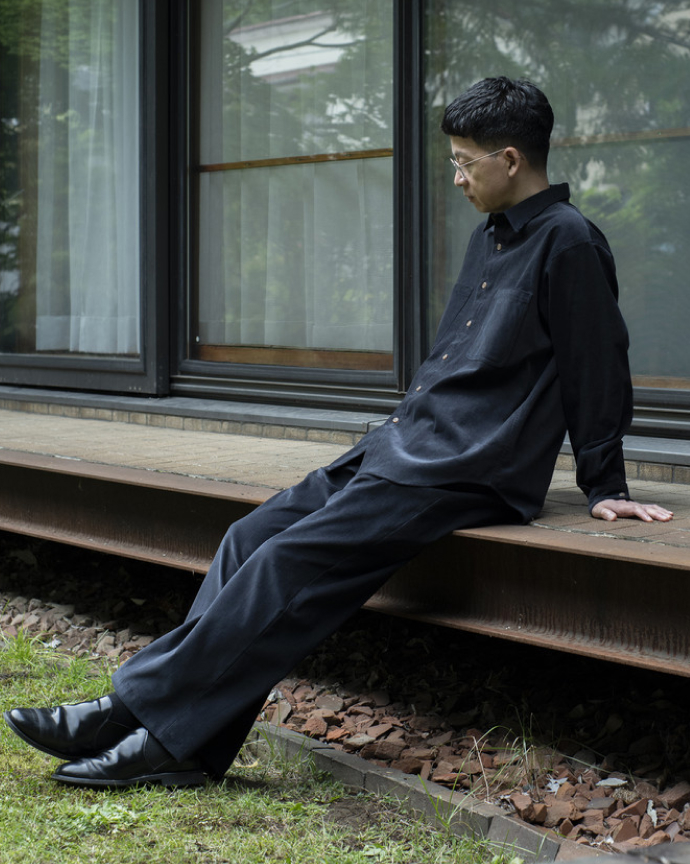
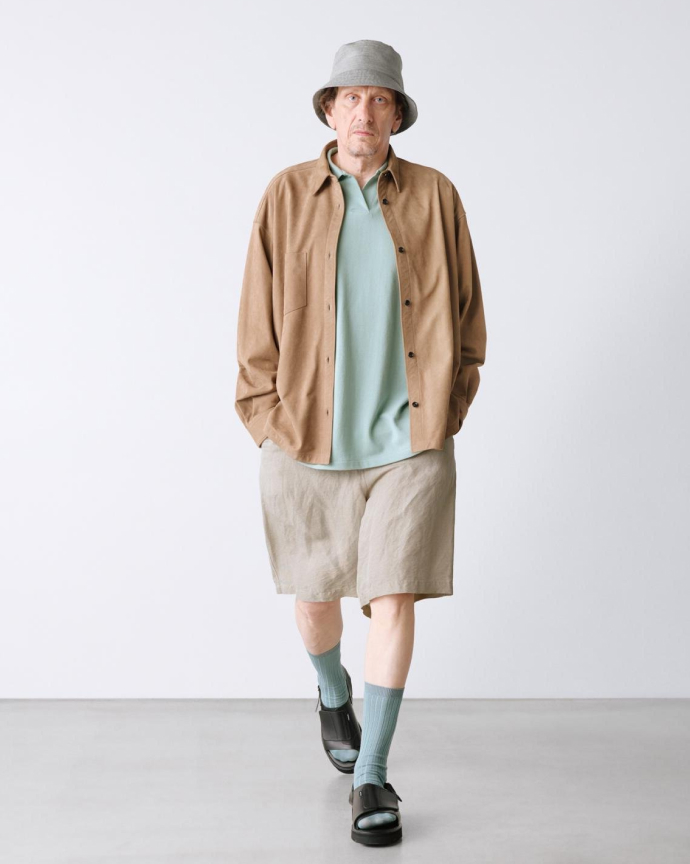
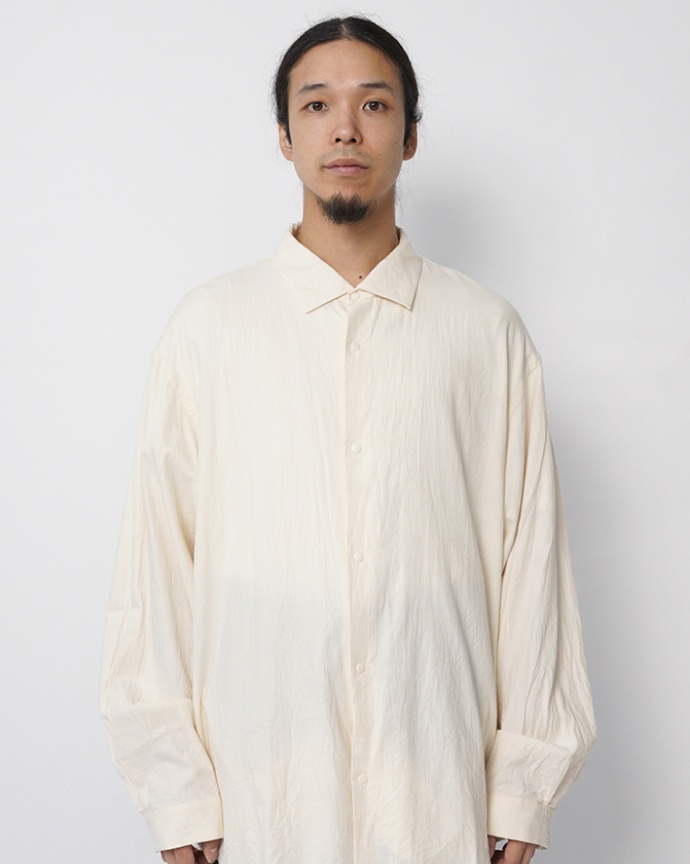
ORRS's selection is curated by the owner, Yosuke, who truly wants to wear only what he loves every day. The newly arrived 'Sw.HERRINGBONE SUIT' is one of those products. It's a setup filled with Yosuke's dedication. The craftsmanship is so detailed that the artisans say, "It's too difficult for mass production," so it has only been available at ORRS until now, but this time we managed to have some made for Dice and Dice as well. A short bullet-point product description can't convey this level of dedication. So, this time, we spoke directly with Yosuke about his commitment to this setup.
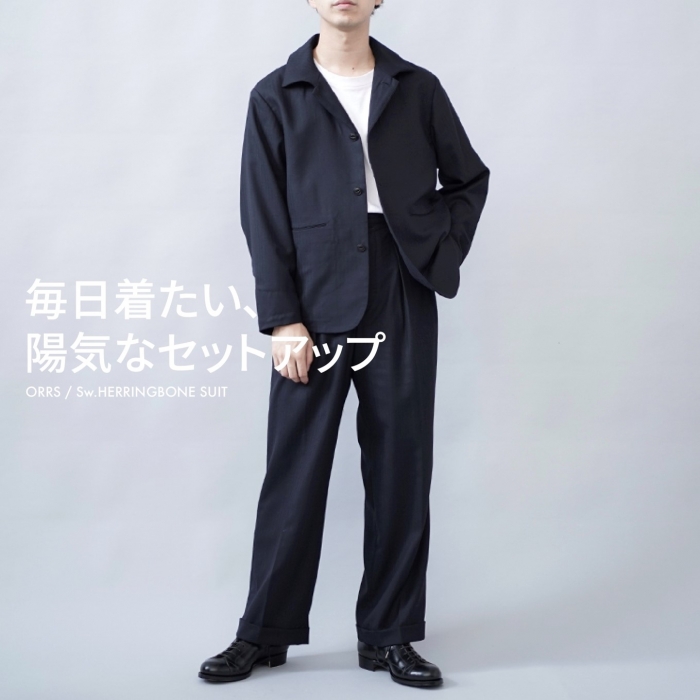
Yosuke: First of all, ORRS has consistently maintained a style with wide pants. Among them, the pants in this setup were designed with the thought that they would look great when the shirt is tucked in.
DD: I see, is it about the front part?
Yosuke: Yes. The two buttons on the front serve to enhance strength, but I intentionally added two buttons to create a slope on the waistband and finished it with a subtly classic two-tuck style. This way, the details of the pants' front become visually appealing when the shirt is tucked in.
DD: Indeed. The presence of the pants increases.
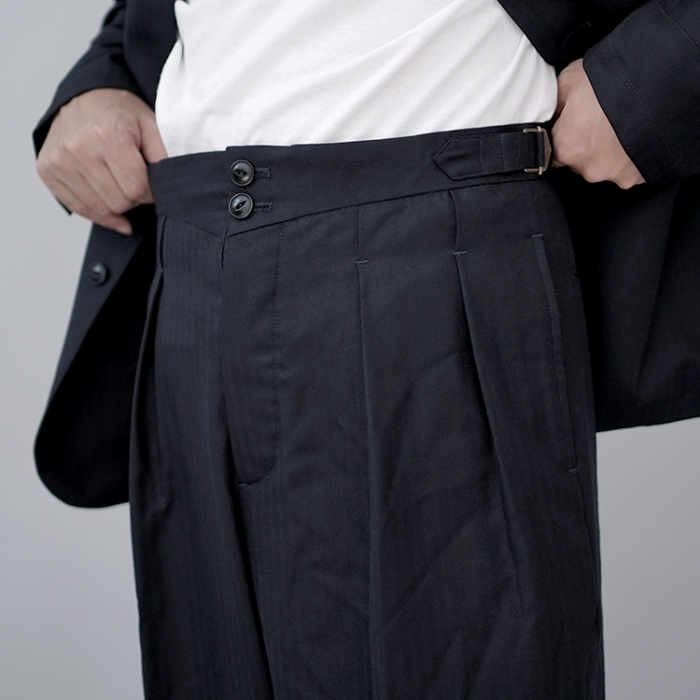 "The waistband is sloped to match the two front buttons. The classic two-tuck design is also a feature."
Yosuke: We pay attention to these small details as well. Usually, the bottom button of a suit jacket is left undone, right? So, when the pants' front is slightly visible from the jacket, I think this kind of detail looks better than just showing the belt.
DD: I see. So, you can wear these without a belt?
Yosuke: Yes, you can wear them without a belt. There are buckles on both sides to adjust the waist. These side buckles are different from the usual ones; they are similar to the cinch backs found on the back of denim.
DD: That's true. Regular side buckles are much simpler in design.
Yosuke: Yes. It takes a lot more effort than making regular side buckles. Simply put, it involves adding two cinch backs to one pair of pants, which is quite challenging. But this looks way cooler, right?
DD: Yes, when the shirt is tucked in, it definitely catches the eye. It combines practicality with solid design.
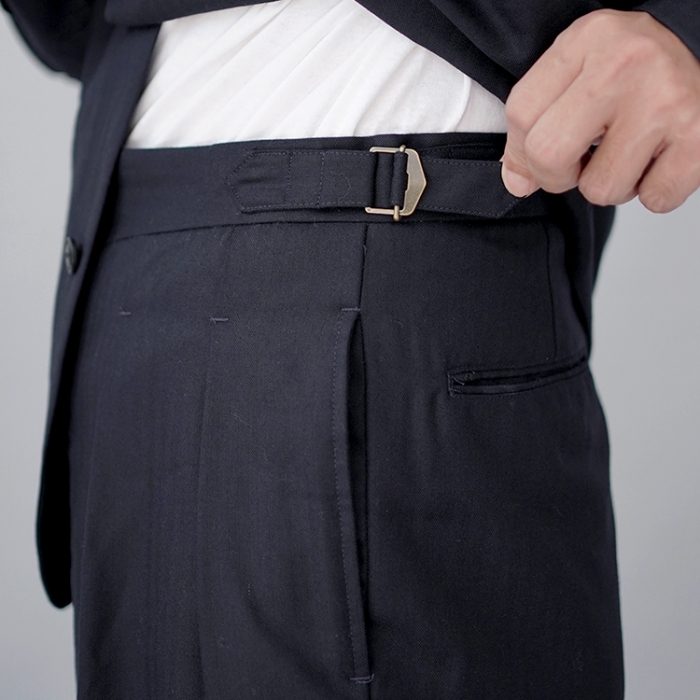 "The cinch back design is used for the side buckles. It takes effort to produce, but it creates a striking detail."
Yosuke: You can also attach suspenders by adding six buttons inside, and if you use alligator clip suspenders, you can wear them as is. Also, not having a belt is great for traveling. You often see people struggling to take off bulky belts when boarding planes, right? (laughs) With this, you can lighten your load and move smoothly.
DD: Yes, I see that often (laughs). But that is indeed bothersome.
Yosuke: This setup was created because I often found myself needing to wear a jacket while traveling. To minimize stress, I used a three-dimensional pattern to attach the sleeves, making it very comfortable to reach forward while dining. There are basically very few suits with such wide arms.
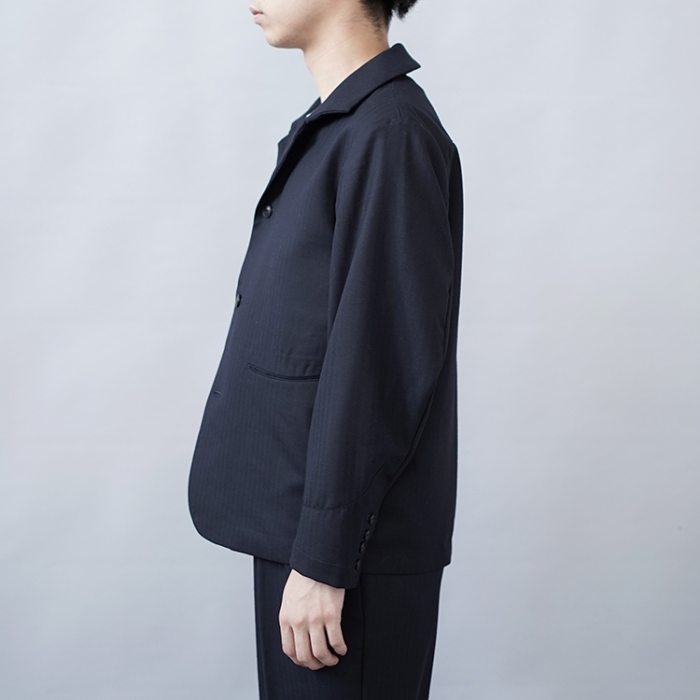 "Unusually wide arms for a suit. Emphasizing ease of movement with a three-dimensional pattern."
DD: I tried it on, and it was incredibly comfortable. It looks sharp but is very easy to move in, and I thought I could wear it for a long time without getting tired.
Yosuke: That's right. I went through several iterations to get that balance just right. There are no shoulder pads, and while it's tailored like a suit, it doesn't have a lining. Having two layers on the back can get quite hot, but this has only one layer, so it's cool.
DD: It feels almost like wearing a shirt.
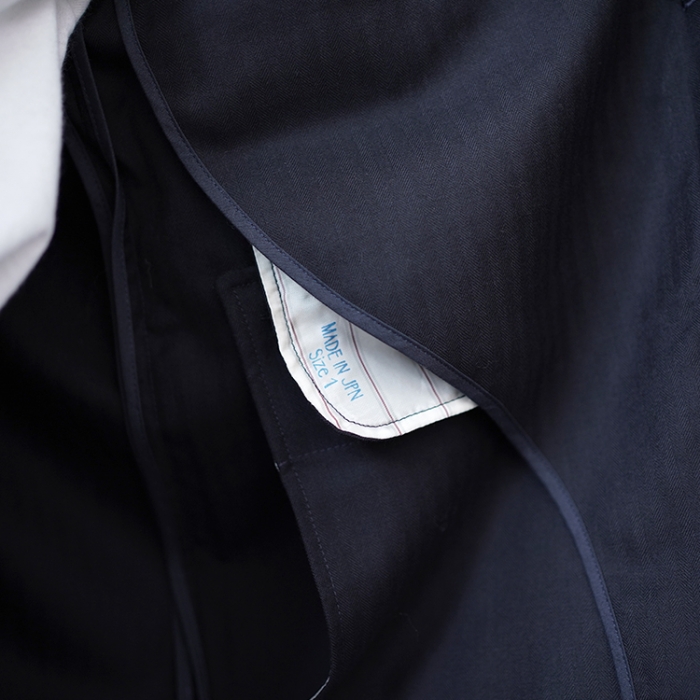 "To keep it lightweight, there is no lining, but careful piping is applied throughout."
Yosuke: Also, instead of the usual suit collar, I made it a coverall style. Of course, you can wear it like a jacket by unbuttoning it. At first glance, it looks like a simple coverall, but if you look closely, you'll see various details that I love mixed in. It's a coverall with Western details.
DD: The jacket pockets are like that too, right?
Yosuke: Yes. Many Western jacket pockets have white piping, but here I've used the same color for the welt. I was very particular about this welt. It's a very thin welt of about 1mm, and making it this thin with a "momi-welt" and curving it at this distance is quite difficult.
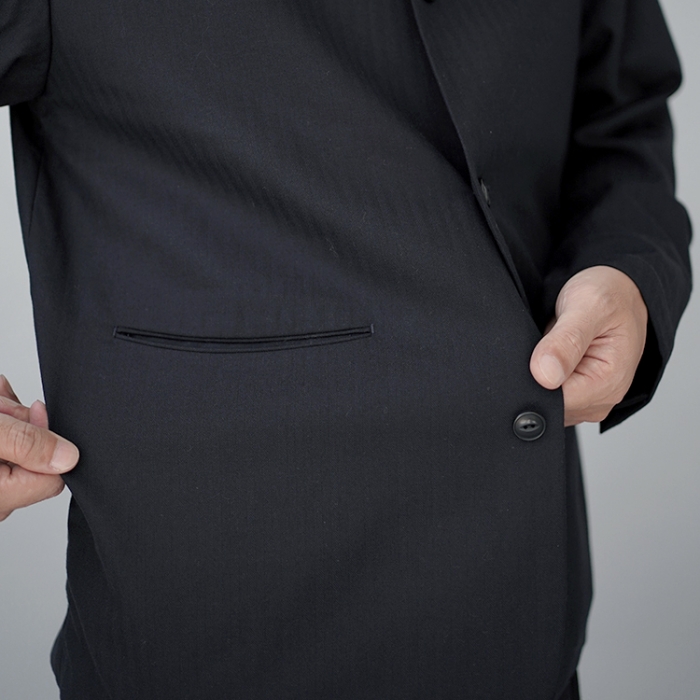 "Pocket design incorporating Western taste. The extremely fine welt curves gently."
DD: That does seem challenging.
Yosuke: Yes, it is. The factory that sews the jackets and the one that sews the pants are different, and we ask each factory to handle what they specialize in. I wanted the pants to have this style of pocket as well, but the pants factory said it was too difficult and refused. I insisted that I had to have this detail on the jacket, so I asked the jacket factory if they could somehow manage it, and they finally agreed. According to the factory, even if a major brand asked them to produce this specification in bulk, they would absolutely refuse because it's too difficult. For a small brand like ours, we can't produce a lot, but we want to create something with great attention to detail. I think that passion was conveyed to the factory, and they found it interesting.
DD: It's a small detail, but if it were just a regular pocket, it would indeed lose its charm. I'm glad your passion was conveyed.
Yosuke: I'm really glad. Thank you. The pockets are not only shaped uniquely but also positioned slightly higher than usual jackets. This raises the line of sight and makes the legs look slimmer. Also, the cuff design features a Western-style cut. The cut is in the same color, so it's not obvious unless you look closely, but even though it's Western, the cuffs open properly with real buttonholes. Additionally, to avoid a bland back view, I've also added a Western-style cut to the back.
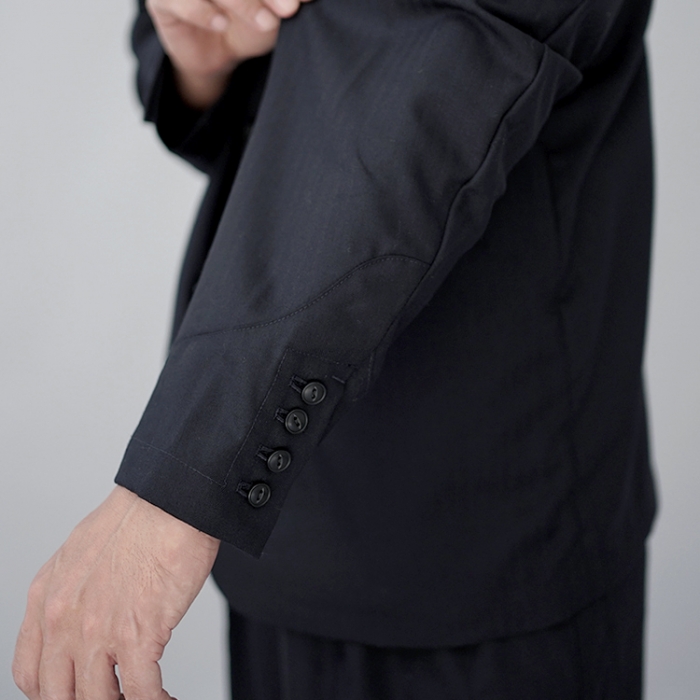 "Western-style cut. The cuff design is not just decorative but features real buttonholes."
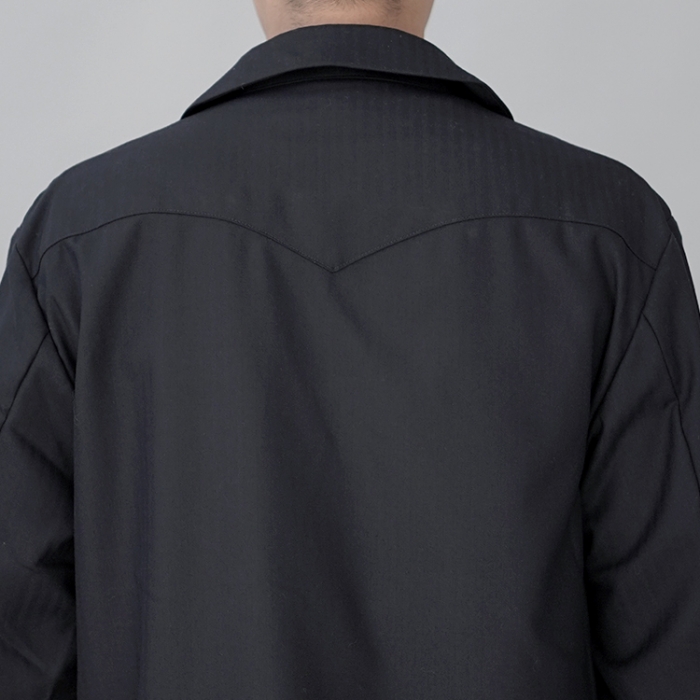 "The back yoke is also Western. The same color cut quietly asserts ORRS's style."
DD: It sounds like the design is packed with elements that Yosuke loves.
Yosuke: Yes. I have had the same style for decades, so I have refined it thoroughly. I think simply reproducing vintage or removing excessive details from it would be a bit boring. If I'm going to make something, I want to create it with the design that is in my head. For example, with Western styles, I think everyone tends to go for black, but since our store is by the sea, I thought about incorporating a bit of a marine style, so I intentionally chose navy. While adding my favorite Western country vibe, I try to keep it subtle and not overdo it.
DD: I see. ORRS's clothing is indeed authentic, but there's always a sense of ORRS's uniqueness. That balance of not going overboard is exquisite.
Yosuke: Thank you. It's challenging, but it's a rewarding aspect.
DD: Next, could you tell me about the fabric?
Yosuke: The fabric, yes. When I used to work at Ralph Lauren, I fell in love with summer wool and wore it all the time. It's technically for summer, but I wore it even in winter. Winter wool slacks are extremely hot, and even living in Tokyo, I only wore them two or three times a year. Don't you sweat unexpectedly when you get on the train or enter a building?
DD: I understand. It's just right outside, but it gets hot indoors. You can take off your jacket, but you can't do that with pants.
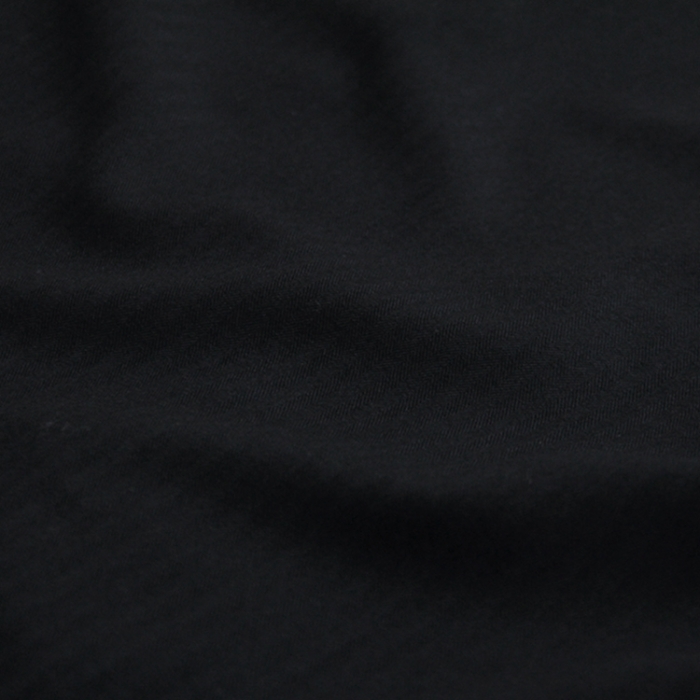 "Deep navy summer wool herringbone fabric. Can be worn in any season and is wrinkle-resistant."
Yosuke: Exactly. That's why summer wool is often useful even in winter, and I think summer wool is the way to go for year-round wear. Also, summer wool is wrinkle-resistant, which is another advantage. If you sit for a long time, cotton would wrinkle, but this fabric holds up well. It's a high-density herringbone, so it has a great texture and is the best fabric. I really love herringbone.
DD: This fabric doesn't wrinkle at all. It has a nice firmness to it.
Yosuke: Right? The color is chosen to be a bit formal and elegant, suitable for occasions like weddings, so I opted for a subdued navy. However, it's more casual than a regular suit, so it definitely works with a T-shirt underneath. But the sewing is done meticulously. If you look at the inside, you'll see that all the seams are piped, and the front placket is made to suit a suit. I always wear a T-shirt underneath and pair it with black sneakers from Tomo&Co for a casual look.
DD: It's great that you can wear it for various occasions. What about the linen fabric?
Yosuke: The linen fabric is also herringbone, but it's a wide-pitch herringbone. However, this is surprisingly rare. There are still narrow-pitch herringbones like those found on military pants, but wide-pitch herringbone is hard to come by. Also, linen is the opposite of summer wool in that it's prone to wrinkling, but that unique wrinkling is part of its charm. As you use it, the fabric changes its expression daily, so you enjoy the changing wrinkles and texture. It feels like a sophisticated adult material.
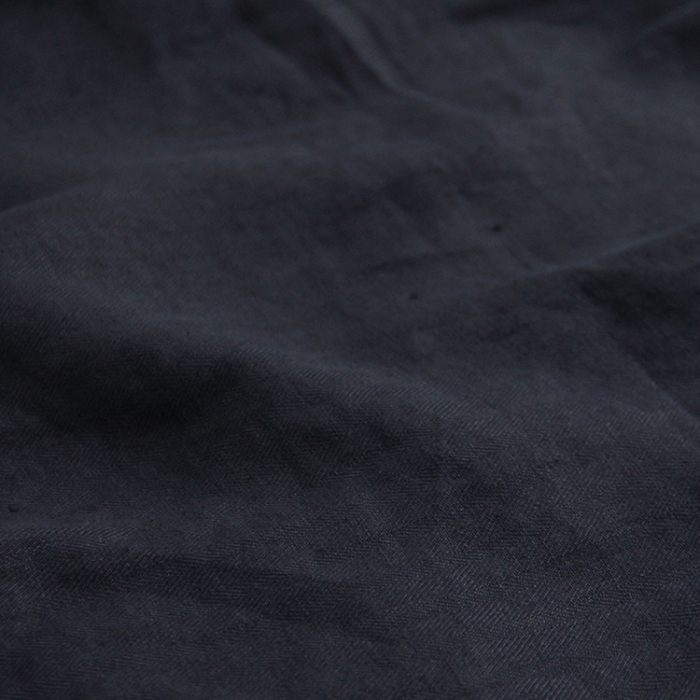 "The rare wide-pitch linen herringbone fabric. I want you to enjoy its unique wrinkling."
DD: I see. Both are hard to choose between.
Yosuke: I love both fabrics.
DD: What kind of styling do you think looks cool when you wear this setup?
Yosuke: Well, I think a cool styling would be to tuck in a waffle thermal from Inoue Brothers inside and coordinate simply with a navy x navy monotone. But wearing white to create a clear contrast is also cool. In summer, I wear a Panama hat, and in winter, I wear a beaver hat.
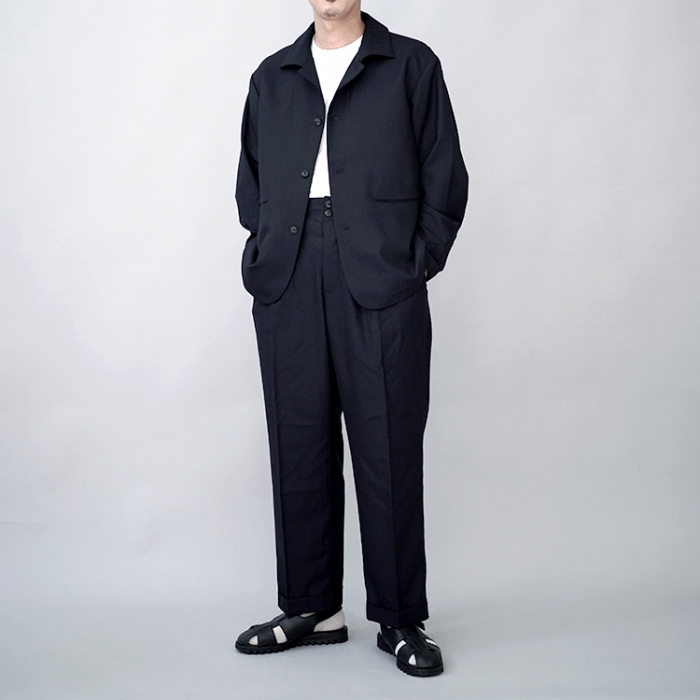 "Styling worn over a cut-and-sew. Even with sandals, it maintains elegance."
DD: If you were to wear a coat when it's cold?
Yosuke: When I throw something over the setup, I think any overcoat, like a trench coat, would work well. Since the setup is dark, gray tones would match, and navy would also be fine. I usually wear a rubberized coat over it. When it's really cold, I wear a mock neck thermal under the setup. I think wearing a turtleneck or mock neck casually with this kind of relaxed suit looks cool rather than being overly dressed up.
DD: What do you do when you want to dress up?
Yosuke: When I want to dress up, I use a scarf. I think just draping a scarf in winter looks stylish. For example, a paisley scarf can add a touch of elegance. It looks great even with a coat over it. I'm always conscious of that subtle peek of detail. Since it's simple clothing, I aim for a look that subtly shows just a hint of detail rather than going overboard.
DD: Thank you. That's very helpful. It's important to incorporate style into everyday life naturally rather than just dressing up.
Yosuke: First of all, ORRS has consistently maintained a style with wide pants. Among them, the pants in this setup were designed with the thought that they would look great when the shirt is tucked in.
DD: I see, is it about the front part?
Yosuke: Yes. The two buttons on the front serve to enhance strength, but I intentionally added two buttons to create a slope on the waistband and finished it with a subtly classic two-tuck style. This way, the details of the pants' front become visually appealing when the shirt is tucked in.
DD: Indeed. The presence of the pants increases.
"The waistband is sloped to match the two front buttons. The classic two-tuck design is also a feature." Yosuke: We pay attention to these small details as well. Usually, the bottom button of a suit jacket is left undone, right? So, when the pants' front is slightly visible from the jacket, I think this kind of detail looks better than just showing the belt.
DD: I see. So, you can wear these without a belt?
Yosuke: Yes, you can wear them without a belt. There are buckles on both sides to adjust the waist. These side buckles are different from the usual ones; they are similar to the cinch backs found on the back of denim.
DD: That's true. Regular side buckles are much simpler in design.
Yosuke: Yes. It takes a lot more effort than making regular side buckles. Simply put, it involves adding two cinch backs to one pair of pants, which is quite challenging. But this looks way cooler, right?
DD: Yes, when the shirt is tucked in, it definitely catches the eye. It combines practicality with solid design.
"The cinch back design is used for the side buckles. It takes effort to produce, but it creates a striking detail." Yosuke: You can also attach suspenders by adding six buttons inside, and if you use alligator clip suspenders, you can wear them as is. Also, not having a belt is great for traveling. You often see people struggling to take off bulky belts when boarding planes, right? (laughs) With this, you can lighten your load and move smoothly.
DD: Yes, I see that often (laughs). But that is indeed bothersome.
Yosuke: This setup was created because I often found myself needing to wear a jacket while traveling. To minimize stress, I used a three-dimensional pattern to attach the sleeves, making it very comfortable to reach forward while dining. There are basically very few suits with such wide arms.
"Unusually wide arms for a suit. Emphasizing ease of movement with a three-dimensional pattern." DD: I tried it on, and it was incredibly comfortable. It looks sharp but is very easy to move in, and I thought I could wear it for a long time without getting tired.
Yosuke: That's right. I went through several iterations to get that balance just right. There are no shoulder pads, and while it's tailored like a suit, it doesn't have a lining. Having two layers on the back can get quite hot, but this has only one layer, so it's cool.
DD: It feels almost like wearing a shirt.
"To keep it lightweight, there is no lining, but careful piping is applied throughout." Yosuke: Also, instead of the usual suit collar, I made it a coverall style. Of course, you can wear it like a jacket by unbuttoning it. At first glance, it looks like a simple coverall, but if you look closely, you'll see various details that I love mixed in. It's a coverall with Western details.
DD: The jacket pockets are like that too, right?
Yosuke: Yes. Many Western jacket pockets have white piping, but here I've used the same color for the welt. I was very particular about this welt. It's a very thin welt of about 1mm, and making it this thin with a "momi-welt" and curving it at this distance is quite difficult.
"Pocket design incorporating Western taste. The extremely fine welt curves gently." DD: That does seem challenging.
Yosuke: Yes, it is. The factory that sews the jackets and the one that sews the pants are different, and we ask each factory to handle what they specialize in. I wanted the pants to have this style of pocket as well, but the pants factory said it was too difficult and refused. I insisted that I had to have this detail on the jacket, so I asked the jacket factory if they could somehow manage it, and they finally agreed. According to the factory, even if a major brand asked them to produce this specification in bulk, they would absolutely refuse because it's too difficult. For a small brand like ours, we can't produce a lot, but we want to create something with great attention to detail. I think that passion was conveyed to the factory, and they found it interesting.
DD: It's a small detail, but if it were just a regular pocket, it would indeed lose its charm. I'm glad your passion was conveyed.
Yosuke: I'm really glad. Thank you. The pockets are not only shaped uniquely but also positioned slightly higher than usual jackets. This raises the line of sight and makes the legs look slimmer. Also, the cuff design features a Western-style cut. The cut is in the same color, so it's not obvious unless you look closely, but even though it's Western, the cuffs open properly with real buttonholes. Additionally, to avoid a bland back view, I've also added a Western-style cut to the back.
"Western-style cut. The cuff design is not just decorative but features real buttonholes."
"The back yoke is also Western. The same color cut quietly asserts ORRS's style." DD: It sounds like the design is packed with elements that Yosuke loves.
Yosuke: Yes. I have had the same style for decades, so I have refined it thoroughly. I think simply reproducing vintage or removing excessive details from it would be a bit boring. If I'm going to make something, I want to create it with the design that is in my head. For example, with Western styles, I think everyone tends to go for black, but since our store is by the sea, I thought about incorporating a bit of a marine style, so I intentionally chose navy. While adding my favorite Western country vibe, I try to keep it subtle and not overdo it.
DD: I see. ORRS's clothing is indeed authentic, but there's always a sense of ORRS's uniqueness. That balance of not going overboard is exquisite.
Yosuke: Thank you. It's challenging, but it's a rewarding aspect.
DD: Next, could you tell me about the fabric?
Yosuke: The fabric, yes. When I used to work at Ralph Lauren, I fell in love with summer wool and wore it all the time. It's technically for summer, but I wore it even in winter. Winter wool slacks are extremely hot, and even living in Tokyo, I only wore them two or three times a year. Don't you sweat unexpectedly when you get on the train or enter a building?
DD: I understand. It's just right outside, but it gets hot indoors. You can take off your jacket, but you can't do that with pants.
"Deep navy summer wool herringbone fabric. Can be worn in any season and is wrinkle-resistant." Yosuke: Exactly. That's why summer wool is often useful even in winter, and I think summer wool is the way to go for year-round wear. Also, summer wool is wrinkle-resistant, which is another advantage. If you sit for a long time, cotton would wrinkle, but this fabric holds up well. It's a high-density herringbone, so it has a great texture and is the best fabric. I really love herringbone.
DD: This fabric doesn't wrinkle at all. It has a nice firmness to it.
Yosuke: Right? The color is chosen to be a bit formal and elegant, suitable for occasions like weddings, so I opted for a subdued navy. However, it's more casual than a regular suit, so it definitely works with a T-shirt underneath. But the sewing is done meticulously. If you look at the inside, you'll see that all the seams are piped, and the front placket is made to suit a suit. I always wear a T-shirt underneath and pair it with black sneakers from Tomo&Co for a casual look.
DD: It's great that you can wear it for various occasions. What about the linen fabric?
Yosuke: The linen fabric is also herringbone, but it's a wide-pitch herringbone. However, this is surprisingly rare. There are still narrow-pitch herringbones like those found on military pants, but wide-pitch herringbone is hard to come by. Also, linen is the opposite of summer wool in that it's prone to wrinkling, but that unique wrinkling is part of its charm. As you use it, the fabric changes its expression daily, so you enjoy the changing wrinkles and texture. It feels like a sophisticated adult material.
"The rare wide-pitch linen herringbone fabric. I want you to enjoy its unique wrinkling." DD: I see. Both are hard to choose between.
Yosuke: I love both fabrics.
DD: What kind of styling do you think looks cool when you wear this setup?
Yosuke: Well, I think a cool styling would be to tuck in a waffle thermal from Inoue Brothers inside and coordinate simply with a navy x navy monotone. But wearing white to create a clear contrast is also cool. In summer, I wear a Panama hat, and in winter, I wear a beaver hat.
"Styling worn over a cut-and-sew. Even with sandals, it maintains elegance." DD: If you were to wear a coat when it's cold?
Yosuke: When I throw something over the setup, I think any overcoat, like a trench coat, would work well. Since the setup is dark, gray tones would match, and navy would also be fine. I usually wear a rubberized coat over it. When it's really cold, I wear a mock neck thermal under the setup. I think wearing a turtleneck or mock neck casually with this kind of relaxed suit looks cool rather than being overly dressed up.
DD: What do you do when you want to dress up?
Yosuke: When I want to dress up, I use a scarf. I think just draping a scarf in winter looks stylish. For example, a paisley scarf can add a touch of elegance. It looks great even with a coat over it. I'm always conscious of that subtle peek of detail. Since it's simple clothing, I aim for a look that subtly shows just a hint of detail rather than going overboard.
DD: Thank you. That's very helpful. It's important to incorporate style into everyday life naturally rather than just dressing up.