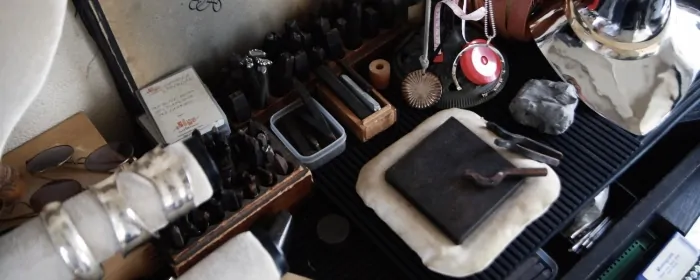
A refined modern design coexists with traditional craftsmanship within a single worldview. The diverse appeal of "Garden of Eden" largely stems from the duality of designer Ryuki Maeda, who excels in both design and craftsmanship. In this interview, we discussed various topics, including what led Maeda to pursue a career in accessories, his experiences during four years in New York, and collaborations.
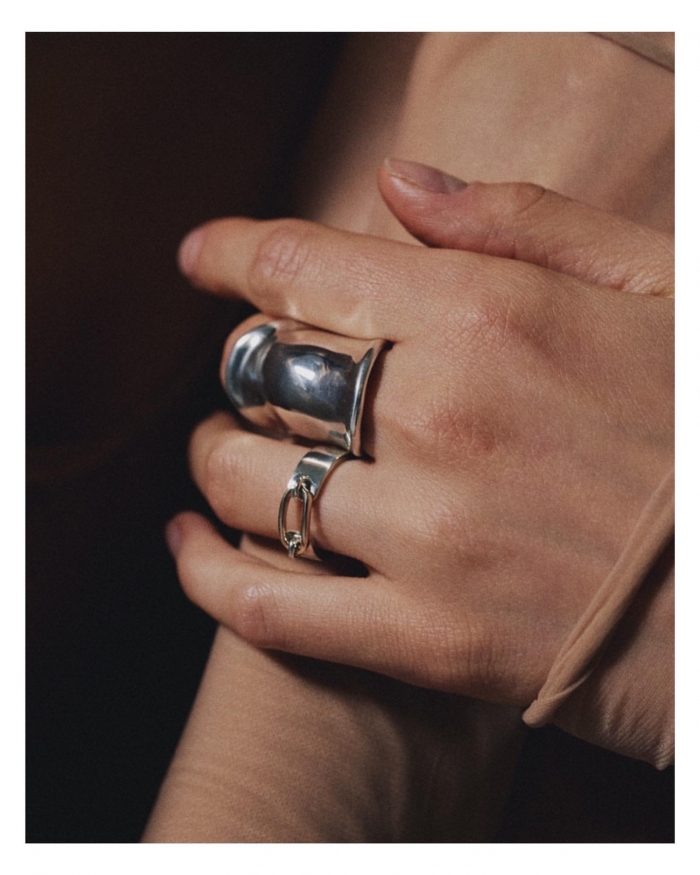
Dice&Dice (hereafter D): Could you tell us about how you came to work in accessories and your memories from that time?
Ryuki Maeda (hereafter Maeda): Actually, my family runs a long-established kimono shop, so I grew up surrounded by kimonos. Naturally, I thought I would take over the family business. I started training to become a kimono merchant from elementary school, learning about family crests and dyeing, but by middle school, I became interested in Western clothing and went to fashion school.
D: Was that a vocational school?
Maeda: Yes, a fashion vocational school. I studied fashion there, but I think I played too much and ended up somewhat discouraged (laughs). Vocational school has a part where you go to have fun, right? (laughs)
D: I can relate to that. I also dropped out of vocational school (laughs).
Maeda: After that, I thought I wanted to work in the fashion industry, no matter what, and during my job search, the first place I got accepted was in the accessories industry. So, I kind of stumbled upon accessories by chance, but that changed my perspective on accessories and jewelry. Eventually, I happened to live in New York.
D: New York?
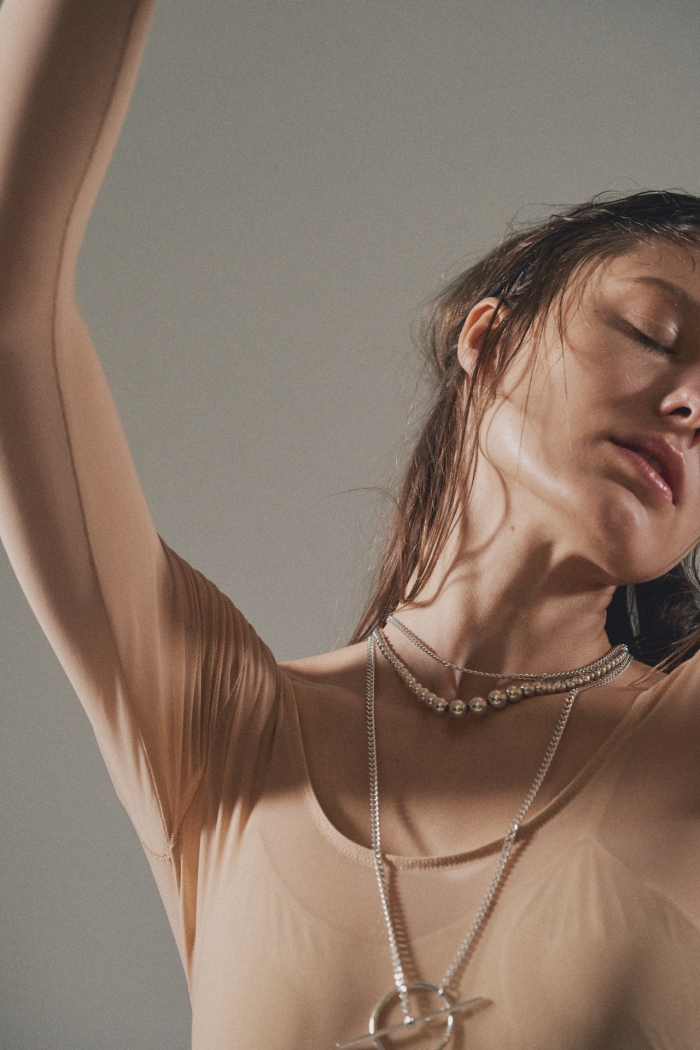
Maeda: Yes. I was recognized by the president of the company, and I was entrusted with brand direction, branding, and buying in New York. On weekends, I would go to flea markets and buy vintage accessories, and those experiences have become elements in my current designs.
D: So, you learned a lot while buying?
Maeda: Exactly. At that time, I knew a bit about clothing, but I hardly knew anything about accessories. However, when I went to flea markets or antique fairs, there would be grandmothers selling accessories, and they would explain the story behind each item in detail. "This was passed down from this person, and it has this story," they would say. I was very impressed by that. Accessories have historically been used as amulets since ancient times, so they carry a unique history and sentiment.
D: I see. It's not just about selling; they tell a story.
Maeda: Exactly. At least the people at the flea markets in New York can convey the story behind each item they sell. After living in New York for about four years and being exposed to Western culture, I encountered accessories described as antiques or vintage, along with their stories, and I gradually became more and more attracted to accessories.
D: Your experiences at the flea markets in New York have become elements in your accessory designs. Could you elaborate on that?
Maeda: While listening to stories at flea markets and antique fairs, I collected various accessories and materials. I’ve always liked collecting, so now I have thousands of vintage samples and materials at hand. That has become the source for my current designs. Accessories always have motifs, like stars, hearts, or crosses. As I collect many of these, I gradually start to understand them. For example, combining elements from one genre with those from a completely different genre of native accessories. I think it's interesting for us Japanese to do that.
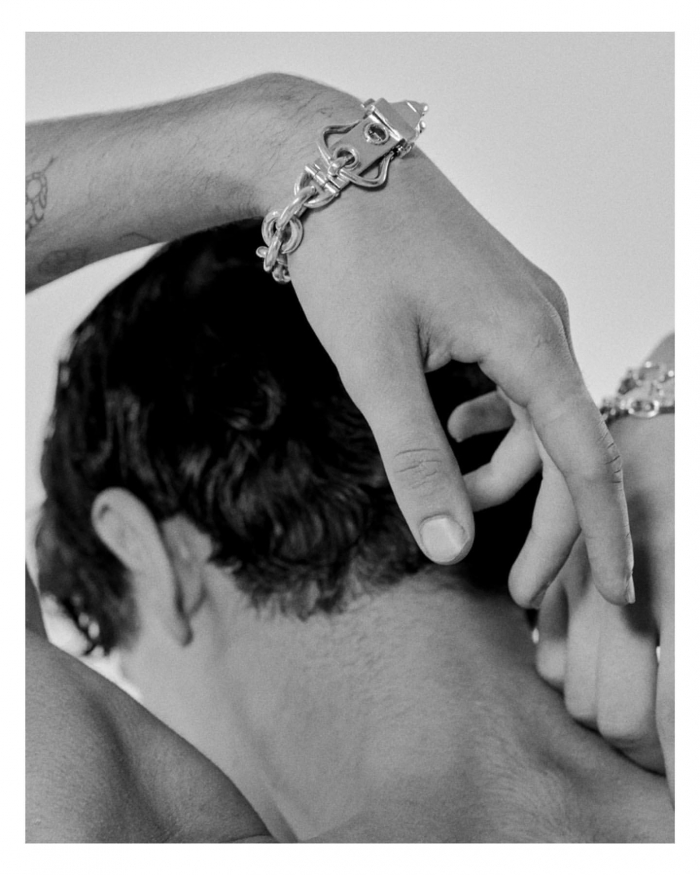
D: There are designs in your work that incorporate techniques that have been lost over time, right?
Maeda: Yes, that's right. Nowadays, many things have become commercially oriented, but the creations of our predecessors were made without such considerations. So, I think we can recreate things like clasps or unusual chains and materials that can no longer be made today with our skills. Having reference materials with such techniques allows us to recreate them by looking at them. It might be possible with photos, but having the actual items makes a huge difference. We can further refine those techniques and improve their quality.
D: It seems quite challenging to recreate lost techniques.
Maeda: It depends on the mindset; there are things that can and cannot be done. Tools have advanced since the old days, so we can recreate things that were once done by hand using modern tools.
D: Are there things that cannot be done?
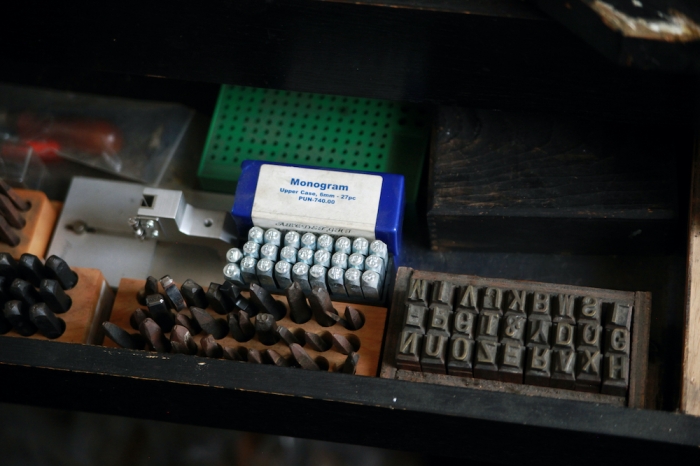
Maeda: Yes. That's why I often buy old tools. For example, if I want to have tools I collected in New York made by craftsmen in Japan now, it would become incredibly expensive. I bought a set of about 40 vintage stamps for around 3000 yen back then, but now if I want to make them, it costs about 30,000 to 40,000 yen each. Since that's for 40 pieces, it would cost hundreds of thousands of yen. That's interesting, isn't it? The charm of vintage. It's a technique that realistically cannot be done now.
D: The designs of Garden of Eden have a vintage feel while also possessing a modern impression, right?
Maeda: Yes, vintage has its own charm, and from there, we refine and polish to finish it in a modern way, which is the concept of Garden of Eden now. However, I don't want to be too constrained by concepts or themes in my designs, so I intentionally set up a framework of series to express within that series.
D: Besides vintage accessories, are there other influences?
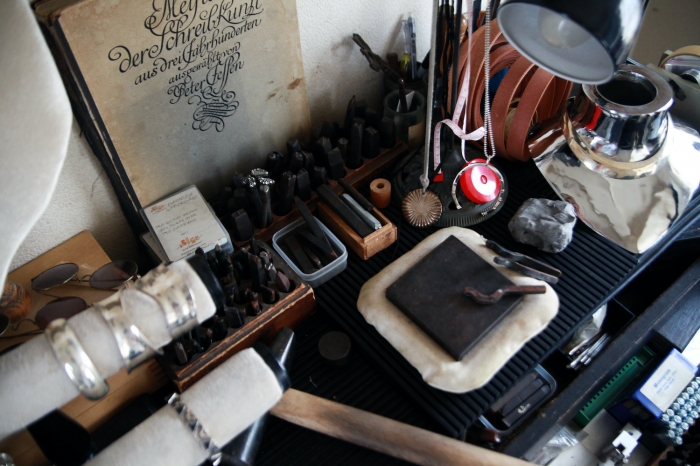
Maeda: Hmm, perhaps fonts. Old scripts or sans-serifs. Also, various architectures and architectural styles. Of course, from Bauhaus to Art Deco. I draw inspiration from things with those design elements. But that can also apply to organic plants, so inspiration can be found everywhere, but if I had to say, I tend to draw more from the past. I believe the roots come from the materials I collected in New York.
D: The materials you have collected are not just accessories and tools, right?
Maeda: Exactly. I have various books. For example, I derive ideas from the pages of those books to create logos and design packaging.
D: Do you handle all those aspects yourself?
Maeda: Yes.
D: I see. You have another craftsman working with you, right?
Maeda: Yes. Our craftsman is really focused on craftsmanship. I feel like I separate my roles between design and craftsmanship, but the craftsman is truly a craftsman. He only works on making things. He repeats making while reading manga (laughs). So, he makes life-size swords from "BLEACH" as a hobby.
D: That's amazing (laughs).
Maeda: Apparently, he made them for children (laughs). But as a craftsman, he enjoys that kind of thing. Nowadays, many accessories are about stripping down, which is modern, but from a craftsman's perspective, adding is more enjoyable. I want to utilize my skills. To be honest, as a craftsman, I prefer adding (laughs). I focus on fine details. But that might not be necessary in today's world, yet I think I have accumulated skills that can be utilized when needed.
D: How do you want people to wear the jewelry you design?
Maeda: Since I take photos for looks, I do have some styling suggestions based on my preferences, but accessories also depend on how they match with clothing. For example, thinking about wearing these earrings with a certain hairstyle, or deciding to wear this in a particular situation. There are various ways to think about it, so I would be happy if people could freely consider and wear them.
■ About this collaboration with Dice&Dice.
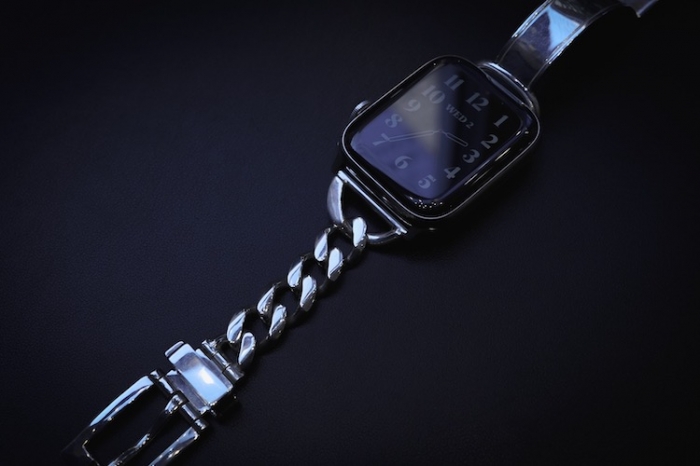
D: During the last pop-up, we collaborated on an Apple Watch band, which received great acclaim. What kind of products will this collaboration feature?
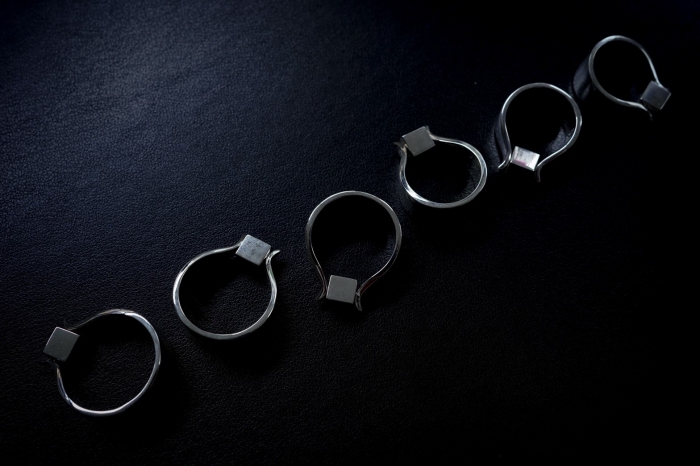
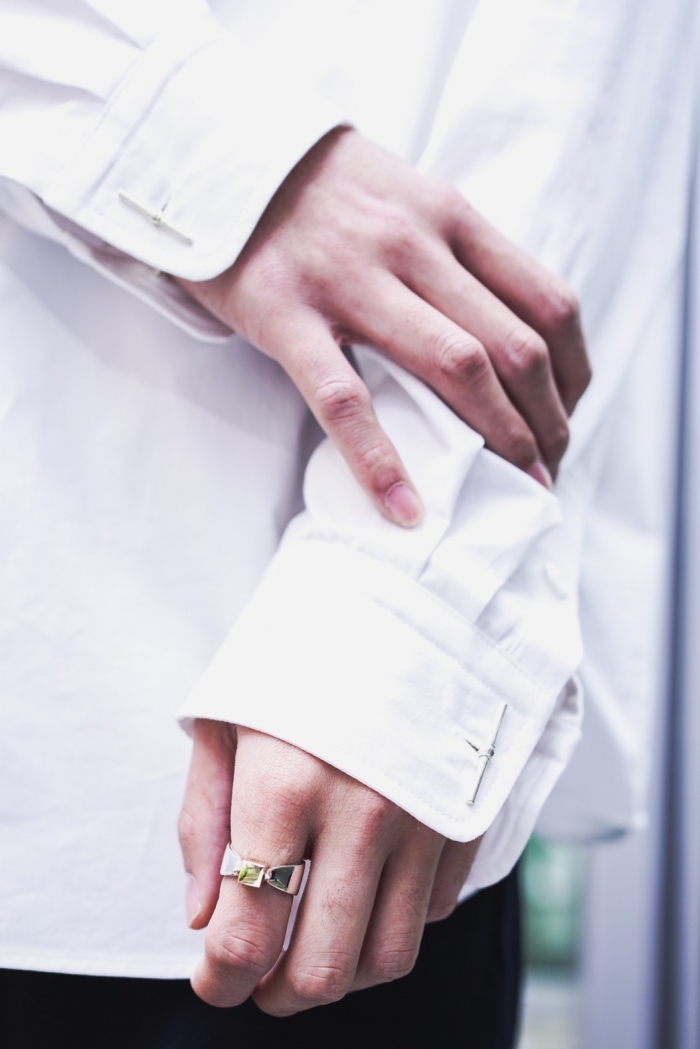
Maeda: While keeping the previous Apple Watch band as a staple in the lineup, I was thinking about what new proposals Dice could offer, and I discussed with Yoshida-san (Dice&Dice director) about creating items that can be freely customized. Accessories are actually a genre where you can engrave names, add stones, or change materials, allowing for a high degree of freedom. So, we designed an item that allows for fun customization and arrangement, with a rotating cube design shaped like a die. You can put your birthstone in the cube like a die, and since it has four sides, you can engrave your favorite numbers or letters. There are size variations for both men and women, so you could create a pair ring with each other's birthstones. Accessories, as I mentioned before, have been used as amulets since ancient times, and unlike clothing, they can truly be worn for a lifetime. Because of that, customizing, arranging, and adding your own color makes them something you can really cherish. I designed it hoping it would be something that captures the interesting aspects of accessories.
■ About the collaboration with Col Pierrot.
D: Could you tell us about your meeting with Fumiko Okuda, the designer of "Col Pierrot," and how the collaboration came to be?
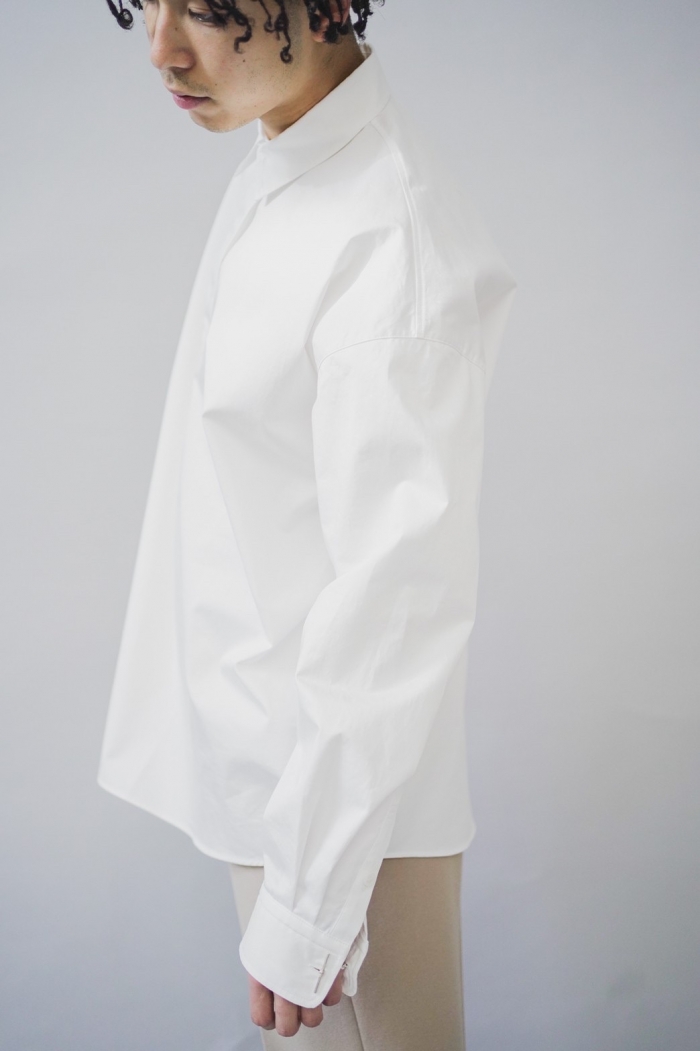
Maeda: By chance, we got to know each other because we were both supplying products to the same store, and she visited our exhibition. When we were thinking about preparing something interesting for the pop-up with Dice, I thought it would be great to collaborate with Col Pierrot, designed by Okuda-san. However, to be honest, I was unsure about asking someone like Okuda-san, who has built a career as a modelist at Chanel and Balenciaga, to collaborate with someone like me who doesn't know much about clothing. But I reached out, hoping she might at least be willing to hear me out.
D: Among many options, why did you choose to collaborate with Col Pierrot, which might be challenging?
Maeda: It might be a craftsman's way of thinking, but I thought that having a long career means having a lot of skills and various resources. I have many friends who are clothing designers, but I wanted to work with Okuda-san, even if it meant it would be expensive. So, I contacted her, and she agreed to meet with me. I went to her atelier, where we discussed this project. I thought it would be interesting to create silver buttons and cufflinks that are unique to us, and she kindly accepted. However, she also had a condition: "Please make those accompanying buttons and cufflinks as well." So, this time, it became a form of mutual provision.
D: It seems you were able to collaborate in a way that satisfied both parties.
Maeda: Yes. I think she found it interesting that we did this. I'm really glad I tried. I was prepared for about 90% of the responses to be rejections. I also think there aren't many brands making shirts using silver buttons as accessories, so I'm glad we could create something interesting.
■ About the collaboration with nella.
D: Could you tell us how the collaboration with Koyama from "nella." came to be?
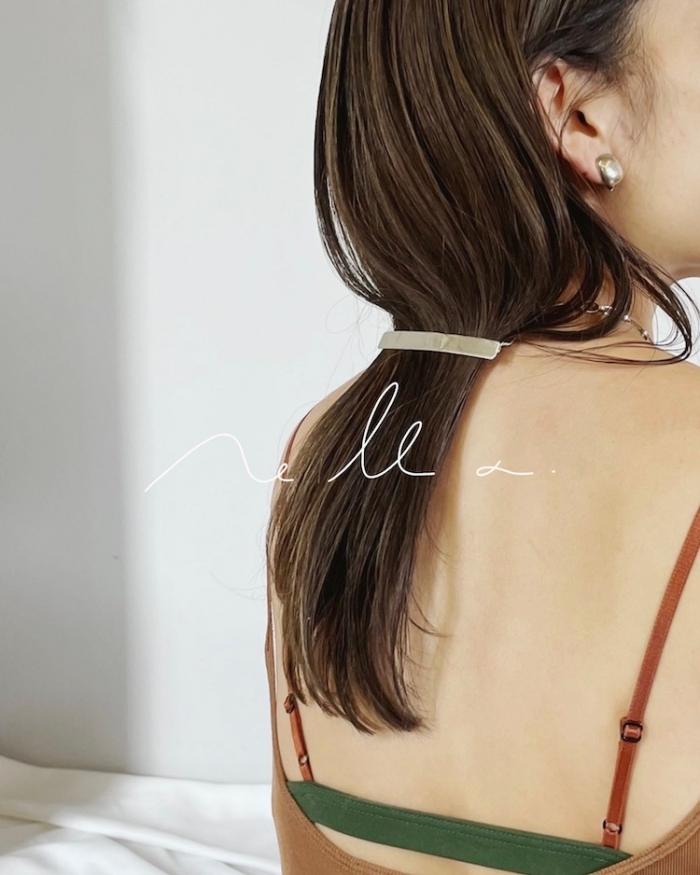
Maeda: The background is, of course, thanks to Yoshida-san's proposal, but the main reason is that Koyama-san always loves and uses Garden products, and I was attracted to the style Koyama-san proposes. By collaborating with Koyama-san, I hope it will provide an opportunity for sophisticated adult women who resonate with Koyama-san's style to see more of Garden's accessories.
D: I believe this is your first time designing hair accessories in earnest. Did you have any new discoveries or find anything interesting?
Maeda: I only had discoveries. I had previously made barrettes, but this time it was a completely different approach. It was my first time thinking about accessories from a hair perspective, so I struggled and made several prototypes without finding the answer. Finally, when I met Koyama-san and talked, I was able to gather my thoughts. Thanks to that, I think we created something really interesting. Of course, it's not the kind of accessory you find in stores, and I believe it will stand out. Honestly, after 20 years in this industry, I thought I had figured out almost everything, but this time I was able to try thinking about creation from a new perspective, and it was filled with unknowns, but it was a lot of fun.
Dice&Dice (hereafter D): Could you tell us about how you came to work in accessories and your memories from that time?
Ryuki Maeda (hereafter Maeda): Actually, my family runs a long-established kimono shop, so I grew up surrounded by kimonos. Naturally, I thought I would take over the family business. I started training to become a kimono merchant from elementary school, learning about family crests and dyeing, but by middle school, I became interested in Western clothing and went to fashion school.
D: Was that a vocational school?
Maeda: Yes, a fashion vocational school. I studied fashion there, but I think I played too much and ended up somewhat discouraged (laughs). Vocational school has a part where you go to have fun, right? (laughs)
D: I can relate to that. I also dropped out of vocational school (laughs).
Maeda: After that, I thought I wanted to work in the fashion industry, no matter what, and during my job search, the first place I got accepted was in the accessories industry. So, I kind of stumbled upon accessories by chance, but that changed my perspective on accessories and jewelry. Eventually, I happened to live in New York.
D: New York?
Maeda: Yes. I was recognized by the president of the company, and I was entrusted with brand direction, branding, and buying in New York. On weekends, I would go to flea markets and buy vintage accessories, and those experiences have become elements in my current designs.
D: So, you learned a lot while buying?
Maeda: Exactly. At that time, I knew a bit about clothing, but I hardly knew anything about accessories. However, when I went to flea markets or antique fairs, there would be grandmothers selling accessories, and they would explain the story behind each item in detail. "This was passed down from this person, and it has this story," they would say. I was very impressed by that. Accessories have historically been used as amulets since ancient times, so they carry a unique history and sentiment.
D: I see. It's not just about selling; they tell a story.
Maeda: Exactly. At least the people at the flea markets in New York can convey the story behind each item they sell. After living in New York for about four years and being exposed to Western culture, I encountered accessories described as antiques or vintage, along with their stories, and I gradually became more and more attracted to accessories.
D: Your experiences at the flea markets in New York have become elements in your accessory designs. Could you elaborate on that?
Maeda: While listening to stories at flea markets and antique fairs, I collected various accessories and materials. I’ve always liked collecting, so now I have thousands of vintage samples and materials at hand. That has become the source for my current designs. Accessories always have motifs, like stars, hearts, or crosses. As I collect many of these, I gradually start to understand them. For example, combining elements from one genre with those from a completely different genre of native accessories. I think it's interesting for us Japanese to do that.
D: There are designs in your work that incorporate techniques that have been lost over time, right?
Maeda: Yes, that's right. Nowadays, many things have become commercially oriented, but the creations of our predecessors were made without such considerations. So, I think we can recreate things like clasps or unusual chains and materials that can no longer be made today with our skills. Having reference materials with such techniques allows us to recreate them by looking at them. It might be possible with photos, but having the actual items makes a huge difference. We can further refine those techniques and improve their quality.
D: It seems quite challenging to recreate lost techniques.
Maeda: It depends on the mindset; there are things that can and cannot be done. Tools have advanced since the old days, so we can recreate things that were once done by hand using modern tools.
D: Are there things that cannot be done?
Maeda: Yes. That's why I often buy old tools. For example, if I want to have tools I collected in New York made by craftsmen in Japan now, it would become incredibly expensive. I bought a set of about 40 vintage stamps for around 3000 yen back then, but now if I want to make them, it costs about 30,000 to 40,000 yen each. Since that's for 40 pieces, it would cost hundreds of thousands of yen. That's interesting, isn't it? The charm of vintage. It's a technique that realistically cannot be done now.
D: The designs of Garden of Eden have a vintage feel while also possessing a modern impression, right?
Maeda: Yes, vintage has its own charm, and from there, we refine and polish to finish it in a modern way, which is the concept of Garden of Eden now. However, I don't want to be too constrained by concepts or themes in my designs, so I intentionally set up a framework of series to express within that series.
D: Besides vintage accessories, are there other influences?
Maeda: Hmm, perhaps fonts. Old scripts or sans-serifs. Also, various architectures and architectural styles. Of course, from Bauhaus to Art Deco. I draw inspiration from things with those design elements. But that can also apply to organic plants, so inspiration can be found everywhere, but if I had to say, I tend to draw more from the past. I believe the roots come from the materials I collected in New York.
D: The materials you have collected are not just accessories and tools, right?
Maeda: Exactly. I have various books. For example, I derive ideas from the pages of those books to create logos and design packaging.
D: Do you handle all those aspects yourself?
Maeda: Yes.
D: I see. You have another craftsman working with you, right?
Maeda: Yes. Our craftsman is really focused on craftsmanship. I feel like I separate my roles between design and craftsmanship, but the craftsman is truly a craftsman. He only works on making things. He repeats making while reading manga (laughs). So, he makes life-size swords from "BLEACH" as a hobby.
D: That's amazing (laughs).
Maeda: Apparently, he made them for children (laughs). But as a craftsman, he enjoys that kind of thing. Nowadays, many accessories are about stripping down, which is modern, but from a craftsman's perspective, adding is more enjoyable. I want to utilize my skills. To be honest, as a craftsman, I prefer adding (laughs). I focus on fine details. But that might not be necessary in today's world, yet I think I have accumulated skills that can be utilized when needed.
D: How do you want people to wear the jewelry you design?
Maeda: Since I take photos for looks, I do have some styling suggestions based on my preferences, but accessories also depend on how they match with clothing. For example, thinking about wearing these earrings with a certain hairstyle, or deciding to wear this in a particular situation. There are various ways to think about it, so I would be happy if people could freely consider and wear them.
■ About this collaboration with Dice&Dice.
D: During the last pop-up, we collaborated on an Apple Watch band, which received great acclaim. What kind of products will this collaboration feature?
Maeda: While keeping the previous Apple Watch band as a staple in the lineup, I was thinking about what new proposals Dice could offer, and I discussed with Yoshida-san (Dice&Dice director) about creating items that can be freely customized. Accessories are actually a genre where you can engrave names, add stones, or change materials, allowing for a high degree of freedom. So, we designed an item that allows for fun customization and arrangement, with a rotating cube design shaped like a die. You can put your birthstone in the cube like a die, and since it has four sides, you can engrave your favorite numbers or letters. There are size variations for both men and women, so you could create a pair ring with each other's birthstones. Accessories, as I mentioned before, have been used as amulets since ancient times, and unlike clothing, they can truly be worn for a lifetime. Because of that, customizing, arranging, and adding your own color makes them something you can really cherish. I designed it hoping it would be something that captures the interesting aspects of accessories.
■ About the collaboration with Col Pierrot.
D: Could you tell us about your meeting with Fumiko Okuda, the designer of "Col Pierrot," and how the collaboration came to be?
Maeda: By chance, we got to know each other because we were both supplying products to the same store, and she visited our exhibition. When we were thinking about preparing something interesting for the pop-up with Dice, I thought it would be great to collaborate with Col Pierrot, designed by Okuda-san. However, to be honest, I was unsure about asking someone like Okuda-san, who has built a career as a modelist at Chanel and Balenciaga, to collaborate with someone like me who doesn't know much about clothing. But I reached out, hoping she might at least be willing to hear me out.
D: Among many options, why did you choose to collaborate with Col Pierrot, which might be challenging?
Maeda: It might be a craftsman's way of thinking, but I thought that having a long career means having a lot of skills and various resources. I have many friends who are clothing designers, but I wanted to work with Okuda-san, even if it meant it would be expensive. So, I contacted her, and she agreed to meet with me. I went to her atelier, where we discussed this project. I thought it would be interesting to create silver buttons and cufflinks that are unique to us, and she kindly accepted. However, she also had a condition: "Please make those accompanying buttons and cufflinks as well." So, this time, it became a form of mutual provision.
D: It seems you were able to collaborate in a way that satisfied both parties.
Maeda: Yes. I think she found it interesting that we did this. I'm really glad I tried. I was prepared for about 90% of the responses to be rejections. I also think there aren't many brands making shirts using silver buttons as accessories, so I'm glad we could create something interesting.
■ About the collaboration with nella.
D: Could you tell us how the collaboration with Koyama from "nella." came to be?
Maeda: The background is, of course, thanks to Yoshida-san's proposal, but the main reason is that Koyama-san always loves and uses Garden products, and I was attracted to the style Koyama-san proposes. By collaborating with Koyama-san, I hope it will provide an opportunity for sophisticated adult women who resonate with Koyama-san's style to see more of Garden's accessories.
D: I believe this is your first time designing hair accessories in earnest. Did you have any new discoveries or find anything interesting?
Maeda: I only had discoveries. I had previously made barrettes, but this time it was a completely different approach. It was my first time thinking about accessories from a hair perspective, so I struggled and made several prototypes without finding the answer. Finally, when I met Koyama-san and talked, I was able to gather my thoughts. Thanks to that, I think we created something really interesting. Of course, it's not the kind of accessory you find in stores, and I believe it will stand out. Honestly, after 20 years in this industry, I thought I had figured out almost everything, but this time I was able to try thinking about creation from a new perspective, and it was filled with unknowns, but it was a lot of fun.