




Fukuoka's 'Orelake' Creators Reunite After Over 10 Years, Leading to Collaboration
2022.03.11 / OTHERS
The inspiration of Ryuhei Daimaru from OVERCOAT can come from anywhere at any time.
One day, I was shown a smartphone screen featuring the Instagram of photographer Kenya Sugai. He is a photographer who won an excellence award at the 31st public recruitment of "Shashin Shinseiki" (Photo New Century) in 2008, a stepping stone for new talents in the Japanese photography world, and surprisingly, he is a former classmate of Daimaru from elementary school. Recently, he has also been in the spotlight for artwork commissioned by Bottega Veneta.
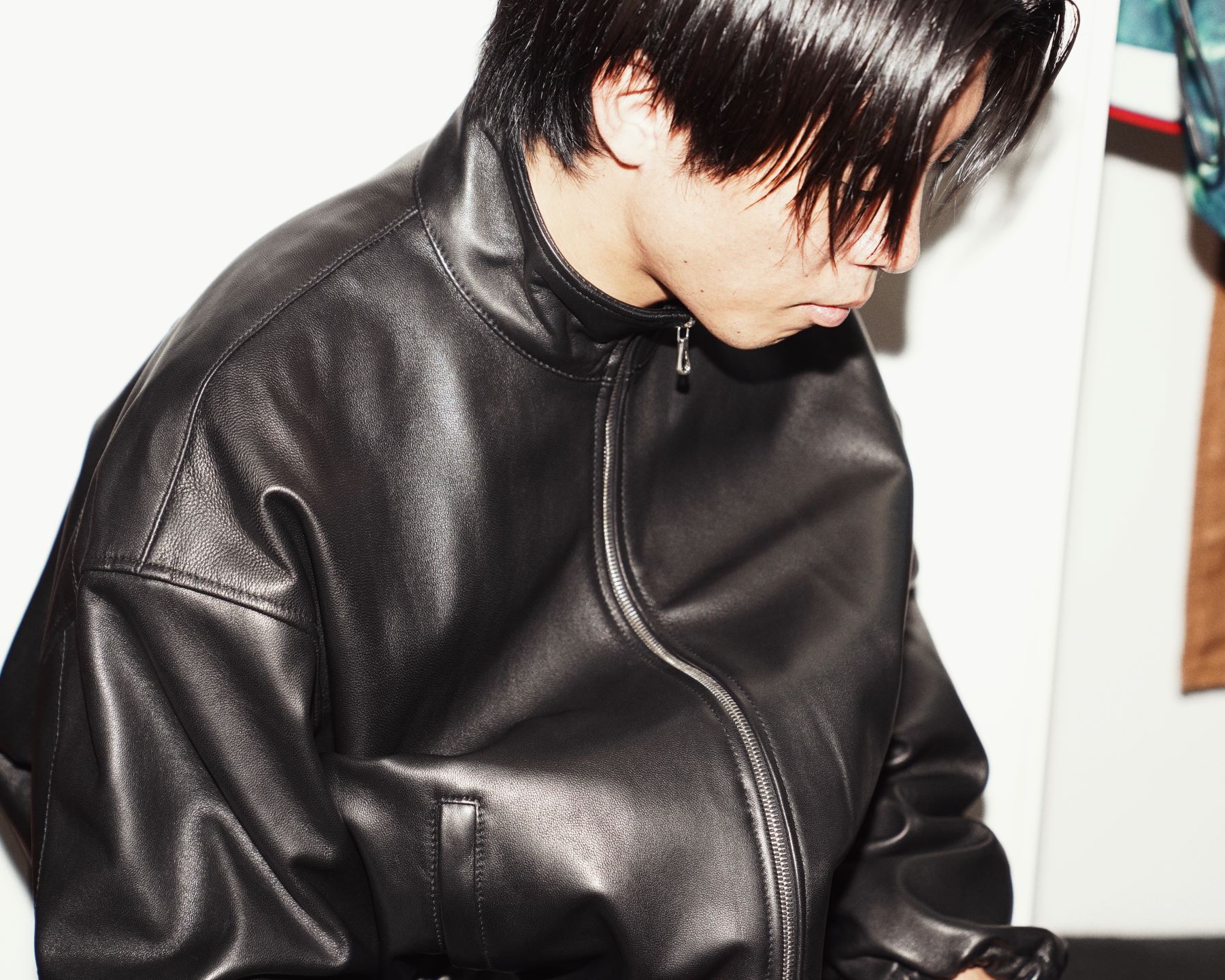
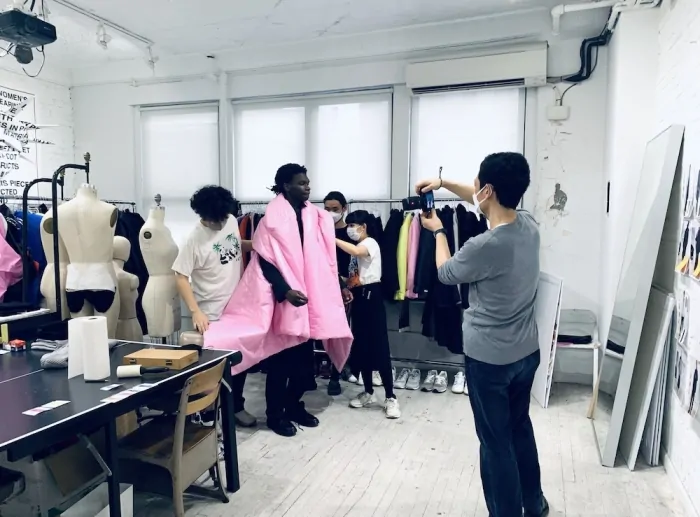
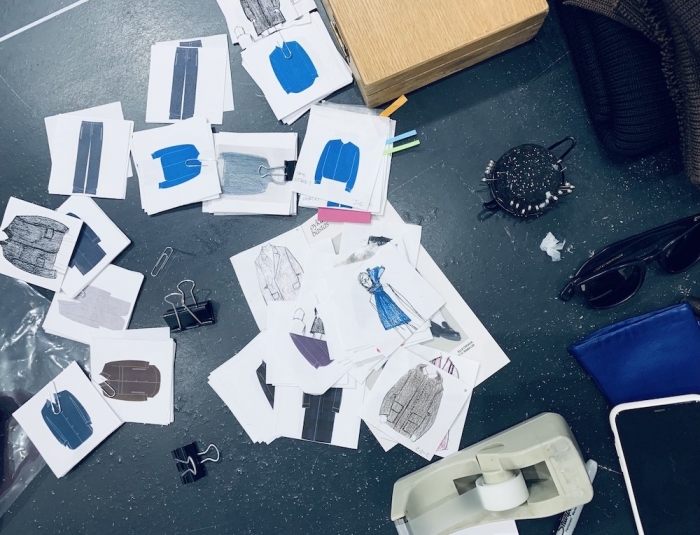
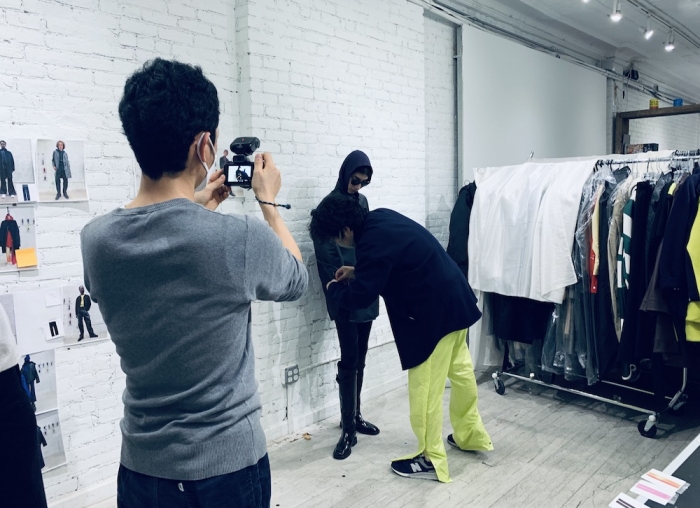
At the beginning of February, I had the opportunity to interview Sugai before and after a fitting, as he was coming to New York for the FW22 lookbook shoot. With the pleasant surprise of discovering such a "hidden gem" in Daimaru, I was convinced that this shooting would surely be something wonderful.
Akiko Ichikawa (A): I heard you were classmates in elementary school, but this is your first time working together, right?
Ryuhei Daimaru (O): I hadn’t seen him in over ten years, but last year I received an email from Suga-chan (Sugai) and we met in Tokyo after a long time. We talked about how it would be nice to do something together. Even though we hadn’t seen each other for so long, we clicked right back into it. He came straight from the airport to my studio, and within 30 minutes we were already scouting locations together. I didn’t even have time to ask if he was tired or if he was okay with the jet lag.
Kenya Sugai (S): I might not have even felt the switch turning on. Seeing what Ooma (Daimaru) was doing in the studio felt just right.
A: What was your childhood like?
O: We entered the same elementary school, and around the 4th or 5th grade, we started going to the same cram school. But it was a cram school where we didn’t study at all (laughs). The head teacher was juggling 6 or 7 classes, so we would just self-study for 1 or 2 hours. So we would sneak out and play under the bridge or go eat ramen, getting into mischief (laughs). That’s how we became friends.
S: After graduating from middle school, Ooma went to a prep school, and I went to a technical high school. One day, we bumped into each other, and when I asked him where he was going, he wouldn’t say anything. But I was persistent (laughs) and said, "If you keep it a secret, I’ll follow you," and I ended up following him for about an hour until we arrived at a boxing gym. That’s when I said, "I’ll learn too."
O: Oh, I remember that. It was a sister school of Osaka Teiken (a prestigious boxing gym).
S: But in the end, I hardly went to boxing anymore. Ooma started working part-time at a udon shop after watching "Ashita no Joe" (Tomorrow's Joe), which is ironic because there’s a symbolic scene in the show where the character Mammoth Nishi (the protagonist's friend) escapes to eat udon, which is the worst thing for a boxer who always has to cut weight.
O: I didn’t really understand "Ashita no Joe" (laughs).
S: In the end, it didn’t last six months, but that encounter made me feel like we were on the same wavelength. What are we talking about? (laughs).
A: Indeed, being fast or having funny jokes makes you popular.
S: Since I wasn’t good at studying, I was always thinking about what else I could do.
O: I would plant seeds of laughter in conversations, creating a story with foreshadowing before making the other person laugh, but Suga-chan would layer on even funnier stories. He has a sharp intuition and always seems to look at the world from a slanted perspective. I’m more logical, while Suga-chan is more intuitive.
S: Ooma was good at studying. I think it was at our middle school graduation ceremony when he wrote that his dream was to appear on "Star Bakushou Q&A." So in high school, he tried to join Yoshimoto in Osaka to become a comedian. But he realized he couldn’t speak in front of a large audience, couldn’t imagine himself as a performer, and quit. It was shocking to give up something he had aimed for until then. While wondering what to do next, he had time, so he went to Ooma’s cultural school (fashion school) entrance ceremony with him.
O: That’s right, that’s right.
S: He has been steadily realizing the dream he has been talking about since high school. What stands out in my memory is that he was bragging about going to Paris Fashion Week since he was a high school student, even to the old man at the local diner. I’m not the type to say such things.
At the time when the movie "Trainspotting" was a hit, I liked subculture and art. So, I went to buy a camera with Ooma in Kyoto and decided to study film in London.
I enrolled in a foundational course before entering university and started taking photos while learning video making. A few years later, when I returned to Japan from London full of confidence, I met Ooma in Tokyo and showed him the photos I took while studying abroad. He said, "These don’t look like Suga-chan; they’re just ordinary photos." They were stylish buildings shot in black and white, and that made me realize, "What is my uniqueness?" After that, I started taking photos of overweight men with a flash.
O: I see, I don’t really remember saying that.
S: For about ten years after that, I consciously worked on returning to myself. I did a series of somewhat ironic photos featuring a police officer and a dog. When I applied for the Photo New Century, I had Ooma help me with the edits. At that time, I was already employed and working in a Japanese designer's atelier. We were also in a noise band together, creating songs and letting the designers listen to them.
A: Amazing! What was the reaction?
O: He took it to Paris, but it wasn’t accepted (laughs). If you say, "I made the audio for the show we’re using this season as a pattern maker," people are usually surprised.
S: At that time, I was trying to create a noise-like sound, and Ooma said, "That won’t work." Even if we leaned towards existing noise music, it wouldn’t be the sound we created ourselves.
In a similar episode, one day while talking about clothes at a clothing store with Ooma, the manager said, "This looks Parisian," as a compliment. Ooma replied, "No, saying it looks Parisian is not good."
A: For the manager, it was probably just a casual comment, but those kinds of things often hit the essence of the matter. Ooma was quite sharp.
S: Since then, we started using "Parisian" to tease people. We often said "our kind." It was about our shared sensibilities and things we liked.
<To be continued in Part 2>
Ryuhei Daimaru
Born in Fukuoka Prefecture. After graduating from Bunka Fashion College, he worked as a pattern maker for Japan's leading maison brands. In 2006, he was scouted by a certain New York brand and moved to the U.S. In 2008, he established the design planning company "oomaru seisakusho 2" in Manhattan, New York. The name is derived from the furniture factory run by his family, and it was founded with the philosophy of creating a new status in fashion based on craftsmanship. The staff is entirely Japanese, continuously conveying the creativity and quality of MADE IN JAPAN to the world. He currently provides planning design, pattern making, and sample sewing services to numerous creators. He started the brand "OVERCOAT" in the autumn/winter season of 2015. In 2016, he established "Oomaru Seisakusho 3" in Jingumae, Tokyo.
(Awards, etc.)
2014: 2nd CFDA FASHION MANUFACTURING INITIATIVE
2015: Won the 33rd Mainichi Fashion Award, Amiko Kujiraoka Award consecutively.
Kenya Sugai
Born in Kyoto Prefecture. Moved to Fukuoka with his family at the age of five. After graduating from high school, he studied film in London. In 2008, he received an excellence award at the 31st public recruitment of "Shashin Shinseiki" (Photo New Century). In addition to creating works, he is active in web magazines such as "Issued by Bottega" for Bottega Veneta, "VICE," and the Japanese version of "Harper’s BAZAAR" and "Numero TOKYO."
Akiko Ichikawa
Based in New York, she handles branding and consulting in the fields of fashion, design, and art. She has been reviewing New York collections for over 20 years and is also involved in editing and writing for newspapers and magazines.
Interview Part 2 - First Half: A Philosophical Discussion on "Holes" with Mr. Daimaru from OVERCOAT.
Interview Part 2 - Second Half: The "Genius" Runner in a Panda T-shirt, Mr. Daimaru, Will Continue to Run.
Interview Part 1: Encountering Dice&Dice and OVERCOAT.
Dice&Dice ONLINE STORE "OVERCOAT" Product List.
One day, I was shown a smartphone screen featuring the Instagram of photographer Kenya Sugai. He is a photographer who won an excellence award at the 31st public recruitment of "Shashin Shinseiki" (Photo New Century) in 2008, a stepping stone for new talents in the Japanese photography world, and surprisingly, he is a former classmate of Daimaru from elementary school. Recently, he has also been in the spotlight for artwork commissioned by Bottega Veneta.
At the beginning of February, I had the opportunity to interview Sugai before and after a fitting, as he was coming to New York for the FW22 lookbook shoot. With the pleasant surprise of discovering such a "hidden gem" in Daimaru, I was convinced that this shooting would surely be something wonderful.
Akiko Ichikawa (A): I heard you were classmates in elementary school, but this is your first time working together, right?
Ryuhei Daimaru (O): I hadn’t seen him in over ten years, but last year I received an email from Suga-chan (Sugai) and we met in Tokyo after a long time. We talked about how it would be nice to do something together. Even though we hadn’t seen each other for so long, we clicked right back into it. He came straight from the airport to my studio, and within 30 minutes we were already scouting locations together. I didn’t even have time to ask if he was tired or if he was okay with the jet lag.
Kenya Sugai (S): I might not have even felt the switch turning on. Seeing what Ooma (Daimaru) was doing in the studio felt just right.
A: What was your childhood like?
O: We entered the same elementary school, and around the 4th or 5th grade, we started going to the same cram school. But it was a cram school where we didn’t study at all (laughs). The head teacher was juggling 6 or 7 classes, so we would just self-study for 1 or 2 hours. So we would sneak out and play under the bridge or go eat ramen, getting into mischief (laughs). That’s how we became friends.
S: After graduating from middle school, Ooma went to a prep school, and I went to a technical high school. One day, we bumped into each other, and when I asked him where he was going, he wouldn’t say anything. But I was persistent (laughs) and said, "If you keep it a secret, I’ll follow you," and I ended up following him for about an hour until we arrived at a boxing gym. That’s when I said, "I’ll learn too."
O: Oh, I remember that. It was a sister school of Osaka Teiken (a prestigious boxing gym).
S: But in the end, I hardly went to boxing anymore. Ooma started working part-time at a udon shop after watching "Ashita no Joe" (Tomorrow's Joe), which is ironic because there’s a symbolic scene in the show where the character Mammoth Nishi (the protagonist's friend) escapes to eat udon, which is the worst thing for a boxer who always has to cut weight.
O: I didn’t really understand "Ashita no Joe" (laughs).
S: In the end, it didn’t last six months, but that encounter made me feel like we were on the same wavelength. What are we talking about? (laughs).
The Logical Daimaru and the Intuitive Sugai
O: Suga-chan was always interesting since childhood. His perspective was different from others, and he was good at making people laugh. When you’re a kid, the types of output are simple.A: Indeed, being fast or having funny jokes makes you popular.
S: Since I wasn’t good at studying, I was always thinking about what else I could do.
O: I would plant seeds of laughter in conversations, creating a story with foreshadowing before making the other person laugh, but Suga-chan would layer on even funnier stories. He has a sharp intuition and always seems to look at the world from a slanted perspective. I’m more logical, while Suga-chan is more intuitive.
S: Ooma was good at studying. I think it was at our middle school graduation ceremony when he wrote that his dream was to appear on "Star Bakushou Q&A." So in high school, he tried to join Yoshimoto in Osaka to become a comedian. But he realized he couldn’t speak in front of a large audience, couldn’t imagine himself as a performer, and quit. It was shocking to give up something he had aimed for until then. While wondering what to do next, he had time, so he went to Ooma’s cultural school (fashion school) entrance ceremony with him.
O: That’s right, that’s right.
S: He has been steadily realizing the dream he has been talking about since high school. What stands out in my memory is that he was bragging about going to Paris Fashion Week since he was a high school student, even to the old man at the local diner. I’m not the type to say such things.
At the time when the movie "Trainspotting" was a hit, I liked subculture and art. So, I went to buy a camera with Ooma in Kyoto and decided to study film in London.
I enrolled in a foundational course before entering university and started taking photos while learning video making. A few years later, when I returned to Japan from London full of confidence, I met Ooma in Tokyo and showed him the photos I took while studying abroad. He said, "These don’t look like Suga-chan; they’re just ordinary photos." They were stylish buildings shot in black and white, and that made me realize, "What is my uniqueness?" After that, I started taking photos of overweight men with a flash.
O: I see, I don’t really remember saying that.
S: For about ten years after that, I consciously worked on returning to myself. I did a series of somewhat ironic photos featuring a police officer and a dog. When I applied for the Photo New Century, I had Ooma help me with the edits. At that time, I was already employed and working in a Japanese designer's atelier. We were also in a noise band together, creating songs and letting the designers listen to them.
A: Amazing! What was the reaction?
O: He took it to Paris, but it wasn’t accepted (laughs). If you say, "I made the audio for the show we’re using this season as a pattern maker," people are usually surprised.
S: At that time, I was trying to create a noise-like sound, and Ooma said, "That won’t work." Even if we leaned towards existing noise music, it wouldn’t be the sound we created ourselves.
In a similar episode, one day while talking about clothes at a clothing store with Ooma, the manager said, "This looks Parisian," as a compliment. Ooma replied, "No, saying it looks Parisian is not good."
A: For the manager, it was probably just a casual comment, but those kinds of things often hit the essence of the matter. Ooma was quite sharp.
S: Since then, we started using "Parisian" to tease people. We often said "our kind." It was about our shared sensibilities and things we liked.
<To be continued in Part 2>
Ryuhei Daimaru
Born in Fukuoka Prefecture. After graduating from Bunka Fashion College, he worked as a pattern maker for Japan's leading maison brands. In 2006, he was scouted by a certain New York brand and moved to the U.S. In 2008, he established the design planning company "oomaru seisakusho 2" in Manhattan, New York. The name is derived from the furniture factory run by his family, and it was founded with the philosophy of creating a new status in fashion based on craftsmanship. The staff is entirely Japanese, continuously conveying the creativity and quality of MADE IN JAPAN to the world. He currently provides planning design, pattern making, and sample sewing services to numerous creators. He started the brand "OVERCOAT" in the autumn/winter season of 2015. In 2016, he established "Oomaru Seisakusho 3" in Jingumae, Tokyo.
(Awards, etc.)
2014: 2nd CFDA FASHION MANUFACTURING INITIATIVE
2015: Won the 33rd Mainichi Fashion Award, Amiko Kujiraoka Award consecutively.
Kenya Sugai
Born in Kyoto Prefecture. Moved to Fukuoka with his family at the age of five. After graduating from high school, he studied film in London. In 2008, he received an excellence award at the 31st public recruitment of "Shashin Shinseiki" (Photo New Century). In addition to creating works, he is active in web magazines such as "Issued by Bottega" for Bottega Veneta, "VICE," and the Japanese version of "Harper’s BAZAAR" and "Numero TOKYO."
Akiko Ichikawa
Based in New York, she handles branding and consulting in the fields of fashion, design, and art. She has been reviewing New York collections for over 20 years and is also involved in editing and writing for newspapers and magazines.
Interview Part 2 - First Half: A Philosophical Discussion on "Holes" with Mr. Daimaru from OVERCOAT.
Interview Part 2 - Second Half: The "Genius" Runner in a Panda T-shirt, Mr. Daimaru, Will Continue to Run.
Interview Part 1: Encountering Dice&Dice and OVERCOAT.
Dice&Dice ONLINE STORE "OVERCOAT" Product List.