
Between Fashion and Art. Ryuhei Daimaru of OVERCOAT talks about his collaboration with contemporary artist Rirkrit Tiravanija.
2022.10.20 / OTHERS
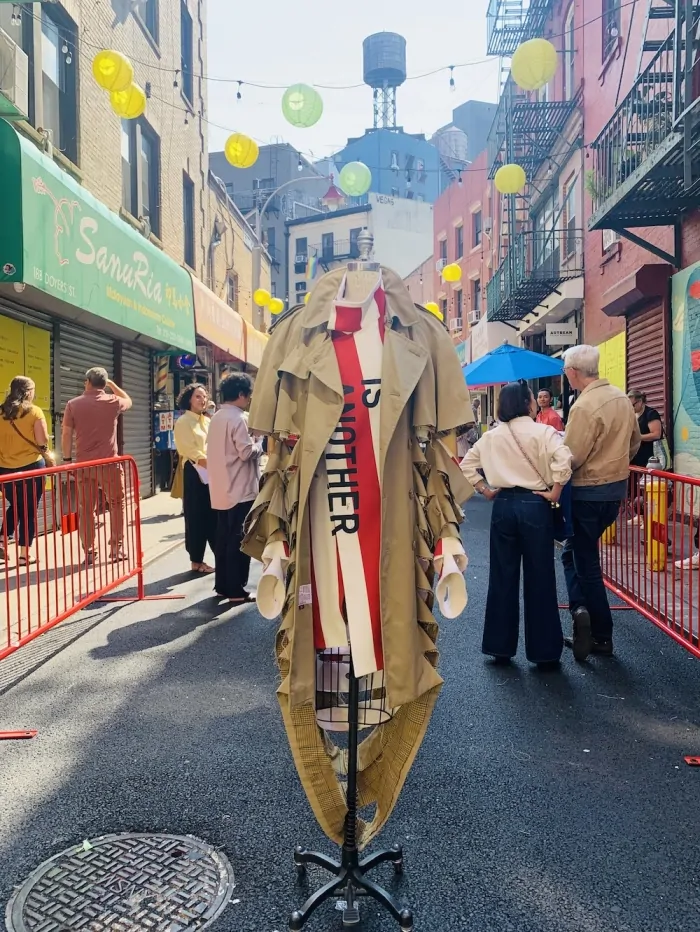
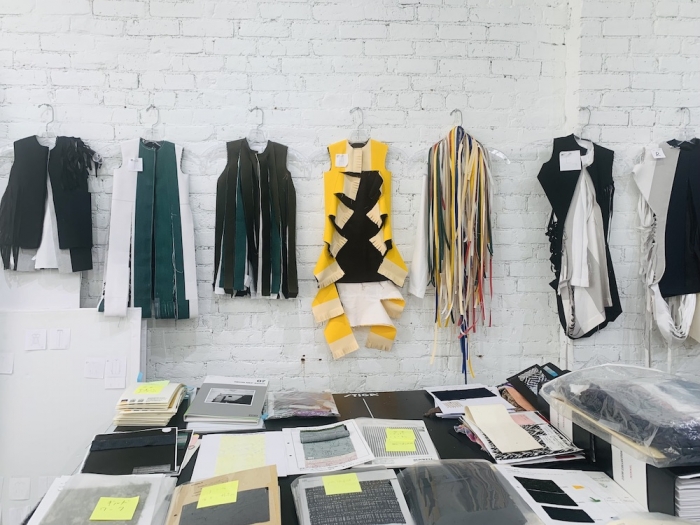
The OVERCOAT collaboration with master artist Rirkrit Tiravanija, titled "COME TOGETHER," was unveiled at the Spring/Summer 2023 New York Fashion Week and is currently on display at the International Contemporary Art Exhibition "Okayama Art Summit" held in Okayama City. The twelve unique pieces, made by layering two coats crafted from vintage clothing and the familiar awning material of OVERCOAT, exude a presence that transcends the boundaries of fashion and art. A dialogue between Takahiro Daimaru and Akiko Ichikawa, the curator of this project.
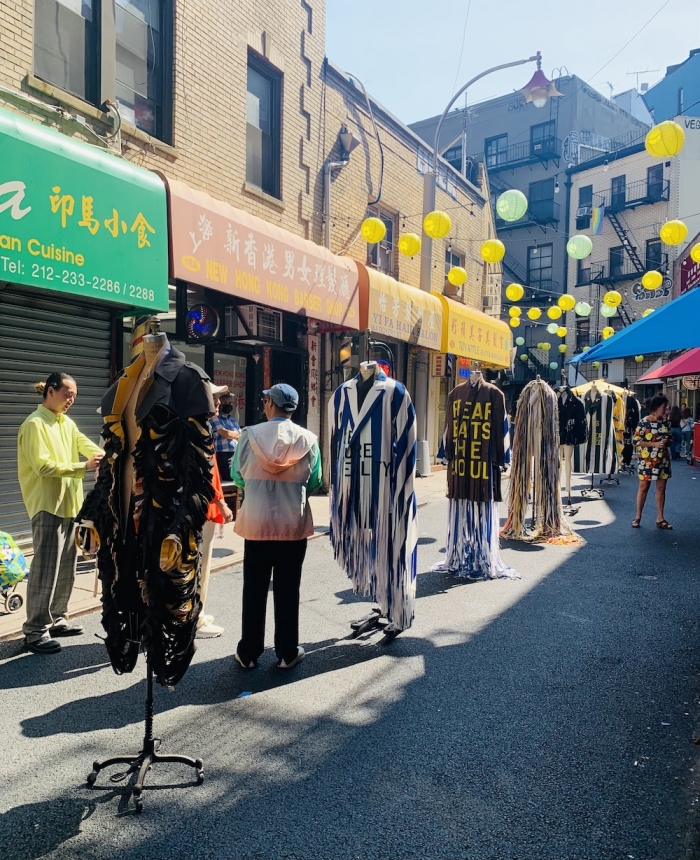
Akiko Ichikawa (A): The origin of this collaboration dates back a year ago when Takahiro came to see Rirkrit's exhibition at THE GALLERY, an art and food project space I curate in New York. When I first introduced Takahiro to Rirkrit, he immediately noticed, "Oh, you're wearing a nice coat," and they hit it off right away.
Takahiro Daimaru (O): At that time, I ended up buying a lot of the collaboration T-shirts between Rirkrit and The Or Foundation that were on display. I don’t usually shop that much, but I resonated with The Or Foundation's activities. Later, he brought his students from a program at Columbia University, where he teaches, to our atelier, and we used OVERCOAT as teaching material.
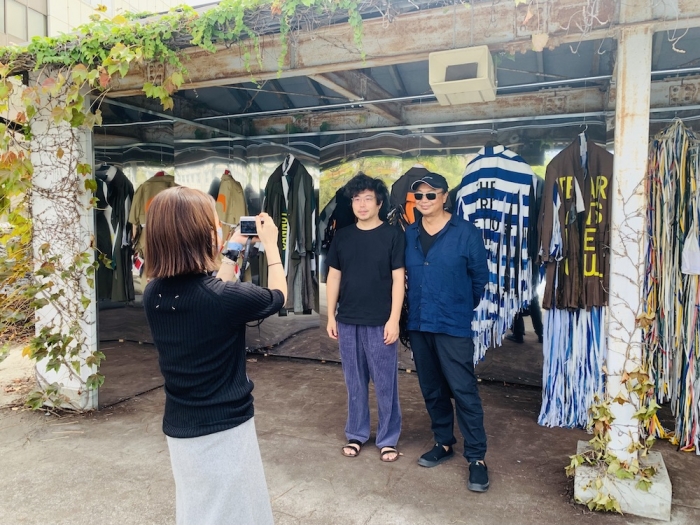
A: The Or Foundation (https://theor.org) is an NPO based in Ghana and the United States that addresses the issue of clothing waste generated by the fashion industry. The excessive apparel products that have emerged due to mass production in developing countries by fast fashion brands that have risen since the 2000s, and consumption trends accelerated by digitalization, are being transported in large quantities to Ghana, causing social inequality and environmental issues. This organization exposes these problems.
As a journalist and a consumer, I have been involved with the fashion industry for many years, and I was truly shocked when I learned about the mountains of discarded clothing along the coastline of Ghana through a report by The Or Foundation. So, last year, I created a piece using T-shirts collected by The Or Foundation before being sent to Ghana during the exhibition at THE GALLERY with Rirkrit and others.
O: This time, we collected vintage coats through The Or Foundation to create the artwork. People often ask whether fashion brands are working on sustainability, but I believe it's not something that can be done casually.
A: OVERCOAT was never about creating things that would be discarded after one season. I am also concerned about the trend of sustainability and SDGs becoming fashionable in the fashion industry. In this context, I feel that this collaboration with Rirkrit has become a symbolic project that raises social issues through a contemporary art approach.
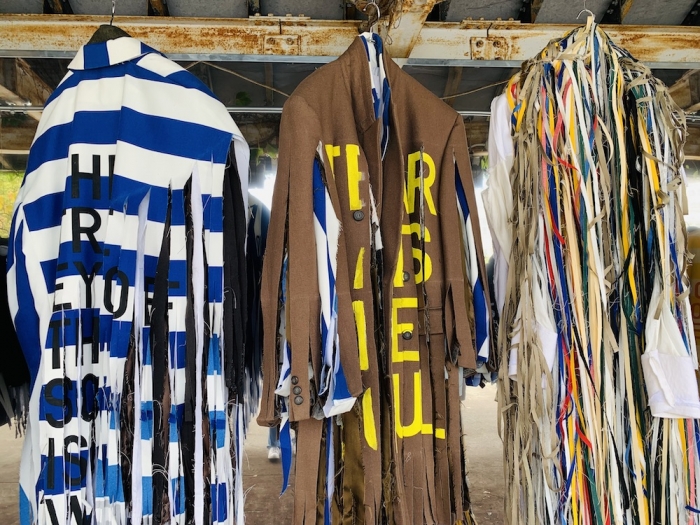
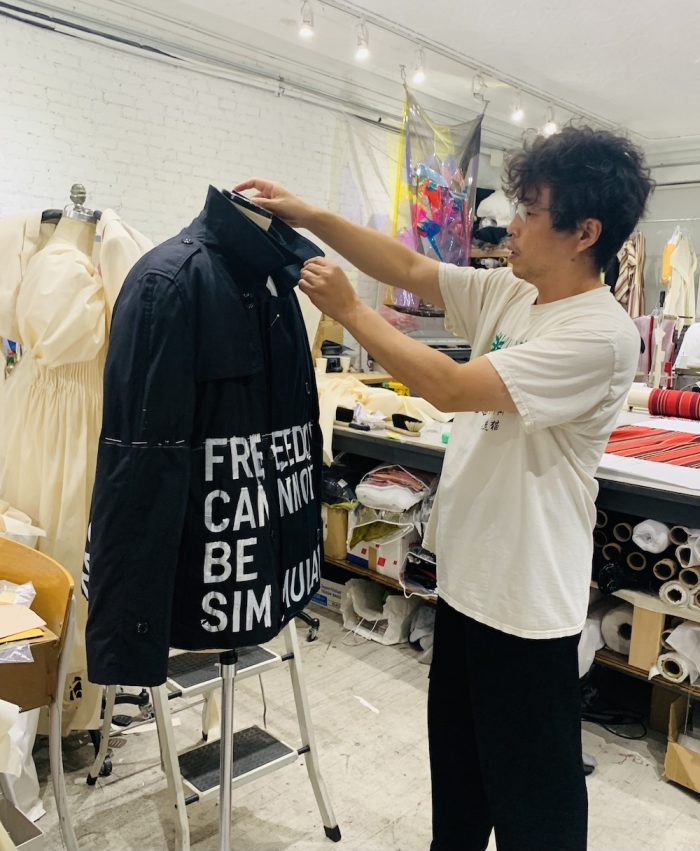
A: The piece "COME TOGETHER" began with Rirkrit printing words like "TOMORROW IS ANOTHER DAY" and "FEAR EATS THE SOUL" using silk screen on the coats, followed by Takahiro finishing it to its final form. All twelve coats utilize shredding techniques.
O: Shredding is a typical technique used when paper or fabric is discarded. Vintage clothing is something that someone has thrown away, but this time we used the shredding technique not for disposal but intentionally for shaping. By layering coats made from the awning material that we have always used at OVERCOAT and shredding them, I wanted to show that they are fused both materially and spiritually.
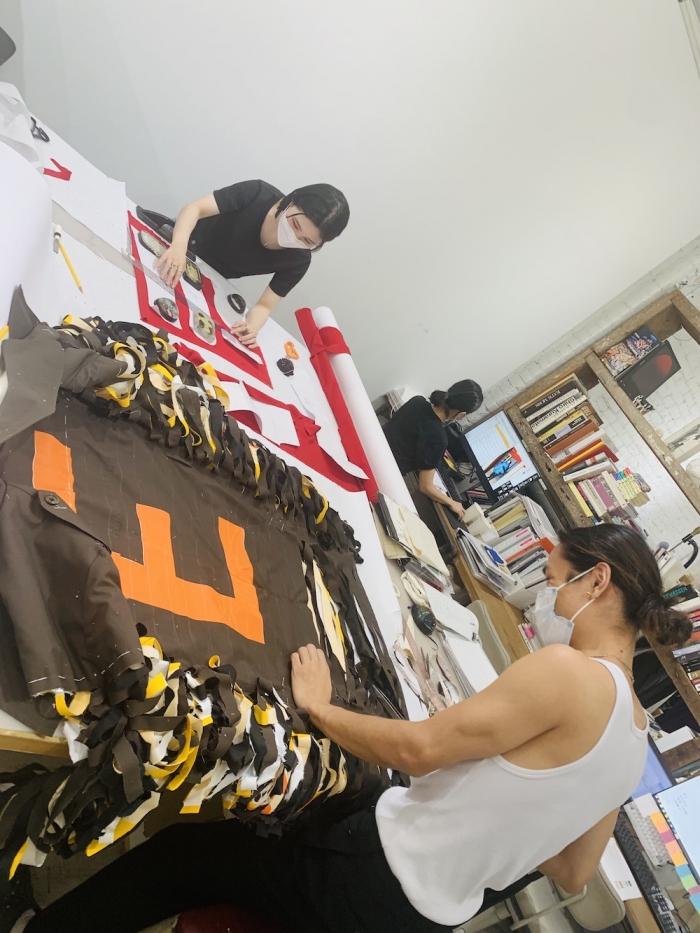
A: You could say that the two coats are “COME TOGETHER” as one piece.
O: That's right. The title was given by Rirkrit, but there is also the famous song by The Beatles. Various artists, including Michael Jackson, have covered it.
In the production process, I first created a miniature of the vintage coat at half size. This is something I do to organize my thoughts, but it’s also a step to consider how the structural lines of the base coat are formed. This project has taken quite a bit of time from conception to completion. I’ve never spent this much time on anything in my designer life.
A: Was the creation of this project intended to be presented as art?
O: Whether it’s art or fashion doesn’t particularly matter. The tension in the creation process was the same as always.
A: If you were to create art, there’s a possibility that the final piece may not be something that can be worn. It could also be a sculptural creation made from vintage coats. The moment the creation is categorized as art rather than fashion, it becomes something untouchable. It gets displayed in galleries or museums, where it cannot be touched or worn.
O: I don’t create with the assumption that people won’t wear it. As long as I’m making clothes, I assume there will be someone to wear them, and I believe they are completed when someone wears them.
A: The aesthetic of relationships at the core of Rirkrit's art. Art performances like making and serving Thai curry, or silk-screen printing slogans on T-shirts, are always completed by someone participating, and can be said to be in the same context.
O: When I make clothes, I often make adjustments that are not visible from the outside, such as changing the color of the inner fabric or adding ease, which only the wearer can understand. It’s a detail of communication where the wearer and I play catch.
The most important thing is whether the clothing can evoke the desire to wear it. There are comfortable clothes that you can wear for over ten hours, like going to work and then out to eat, and there are also clothes like the coats made in this project that make you think or experience something extraordinary even if you wear them for just ten seconds or ten minutes. If the impulse to want to wear it and the interest in wanting to wear it are lost, the clothing is taken lightly and discarded.
Originally, the word art comes from the Latin word ars, which referred to human skill. Until modern times, the term art was more about technical elements rather than artistic ones. As a technician myself, I hope to resonate with wearers through expressions using my skills and ideas.
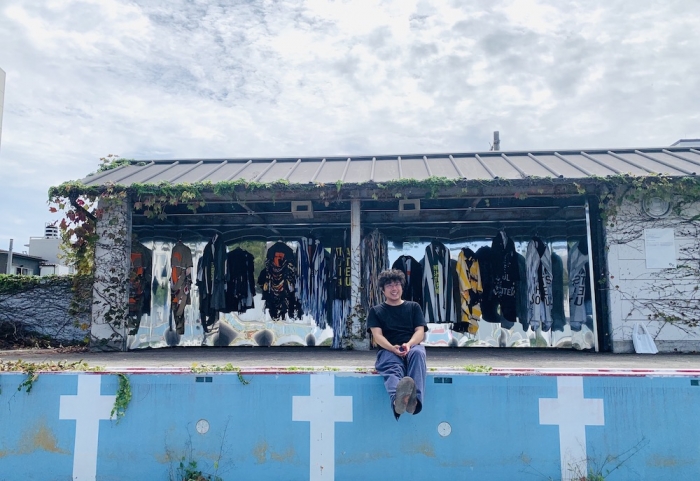
Okayama Art Summit 2022
Period: September 30, 2022 - November 27, 2022
https://www.okayamaartsummit.jp/2022/
OVERCOAT FALL WINTER 2022 LAUNCH EVENT AT DICE&DICE
Period: October 22, 2022 - October 24, 2022
Venue: Dice and Dice
Takahiro Daimaru
Born in Fukuoka Prefecture. After graduating from Bunka Fashion College, he worked as a pattern maker for Japan's leading maison brands. In 2006, he was scouted by a certain New York brand and moved to the U.S. In 2008, he established the design planning company "oomaru seisakusho 2" in Manhattan, New York. The name comes from the furniture factory run by his family, and it was launched with the philosophy of creating a new status in fashion based on craftsmanship. The staff is entirely Japanese, continuously transmitting the creativity and quality of MADE IN JAPAN to the world. He currently provides planning design, pattern making, and sample sewing services to numerous creators. He started the brand "OVERCOAT" in the fall/winter season of 2015. In 2016, he established "Daimaru Seisakusho 3" in Jingumae, Tokyo.
(Awards, etc.)
2014: 2nd CFDA FASHION MANUFACTURING INITIATIVE
2015: Winner of the 33rd Mainichi Fashion Awards, Amiko Kujiraoka Award consecutively.
Akiko Ichikawa
Based in New York, she engages in branding and consulting in the fields of fashion, design, and art. She has been reviewing the New York Collection for over 20 years and is also involved in editing and writing for newspapers and magazines.
Interview Part 3 - First Half "Fukuoka's 'Orel' Creators Reunite After Over Ten Years, Leading to Collaboration"
Interview Part 3 - Second Half "Fukuoka's 'Orel' Creators Reunite After Over Ten Years, Leading to Collaboration"
Interview Part 2 - First Half "Philosophical Discussion About 'Holes' with Mr. Daimaru from OVERCOAT."
Interview Part 2 - Second Half "The 'Genius' Runner in a Panda T-shirt, Mr. Daimaru Will Continue to Run."
Interview Part 1 "Meeting OVERCOAT at Dice&Dice."
Dice&Dice ONLINE STORE "OVERCOAT" Product List
Akiko Ichikawa (A): The origin of this collaboration dates back a year ago when Takahiro came to see Rirkrit's exhibition at THE GALLERY, an art and food project space I curate in New York. When I first introduced Takahiro to Rirkrit, he immediately noticed, "Oh, you're wearing a nice coat," and they hit it off right away.
Takahiro Daimaru (O): At that time, I ended up buying a lot of the collaboration T-shirts between Rirkrit and The Or Foundation that were on display. I don’t usually shop that much, but I resonated with The Or Foundation's activities. Later, he brought his students from a program at Columbia University, where he teaches, to our atelier, and we used OVERCOAT as teaching material.
A: The Or Foundation (https://theor.org) is an NPO based in Ghana and the United States that addresses the issue of clothing waste generated by the fashion industry. The excessive apparel products that have emerged due to mass production in developing countries by fast fashion brands that have risen since the 2000s, and consumption trends accelerated by digitalization, are being transported in large quantities to Ghana, causing social inequality and environmental issues. This organization exposes these problems.
As a journalist and a consumer, I have been involved with the fashion industry for many years, and I was truly shocked when I learned about the mountains of discarded clothing along the coastline of Ghana through a report by The Or Foundation. So, last year, I created a piece using T-shirts collected by The Or Foundation before being sent to Ghana during the exhibition at THE GALLERY with Rirkrit and others.
O: This time, we collected vintage coats through The Or Foundation to create the artwork. People often ask whether fashion brands are working on sustainability, but I believe it's not something that can be done casually.
A: OVERCOAT was never about creating things that would be discarded after one season. I am also concerned about the trend of sustainability and SDGs becoming fashionable in the fashion industry. In this context, I feel that this collaboration with Rirkrit has become a symbolic project that raises social issues through a contemporary art approach.
The fusion of two old and new coats into one piece of artwork
A: The piece "COME TOGETHER" began with Rirkrit printing words like "TOMORROW IS ANOTHER DAY" and "FEAR EATS THE SOUL" using silk screen on the coats, followed by Takahiro finishing it to its final form. All twelve coats utilize shredding techniques.
O: Shredding is a typical technique used when paper or fabric is discarded. Vintage clothing is something that someone has thrown away, but this time we used the shredding technique not for disposal but intentionally for shaping. By layering coats made from the awning material that we have always used at OVERCOAT and shredding them, I wanted to show that they are fused both materially and spiritually.
A: You could say that the two coats are “COME TOGETHER” as one piece.
O: That's right. The title was given by Rirkrit, but there is also the famous song by The Beatles. Various artists, including Michael Jackson, have covered it.
In the production process, I first created a miniature of the vintage coat at half size. This is something I do to organize my thoughts, but it’s also a step to consider how the structural lines of the base coat are formed. This project has taken quite a bit of time from conception to completion. I’ve never spent this much time on anything in my designer life.
Whether the clothing can evoke the impulse to want to wear it.
A: Was the creation of this project intended to be presented as art?
O: Whether it’s art or fashion doesn’t particularly matter. The tension in the creation process was the same as always.
A: If you were to create art, there’s a possibility that the final piece may not be something that can be worn. It could also be a sculptural creation made from vintage coats. The moment the creation is categorized as art rather than fashion, it becomes something untouchable. It gets displayed in galleries or museums, where it cannot be touched or worn.
O: I don’t create with the assumption that people won’t wear it. As long as I’m making clothes, I assume there will be someone to wear them, and I believe they are completed when someone wears them.
A: The aesthetic of relationships at the core of Rirkrit's art. Art performances like making and serving Thai curry, or silk-screen printing slogans on T-shirts, are always completed by someone participating, and can be said to be in the same context.
O: When I make clothes, I often make adjustments that are not visible from the outside, such as changing the color of the inner fabric or adding ease, which only the wearer can understand. It’s a detail of communication where the wearer and I play catch.
The most important thing is whether the clothing can evoke the desire to wear it. There are comfortable clothes that you can wear for over ten hours, like going to work and then out to eat, and there are also clothes like the coats made in this project that make you think or experience something extraordinary even if you wear them for just ten seconds or ten minutes. If the impulse to want to wear it and the interest in wanting to wear it are lost, the clothing is taken lightly and discarded.
Originally, the word art comes from the Latin word ars, which referred to human skill. Until modern times, the term art was more about technical elements rather than artistic ones. As a technician myself, I hope to resonate with wearers through expressions using my skills and ideas.
Okayama Art Summit 2022
Period: September 30, 2022 - November 27, 2022
https://www.okayamaartsummit.jp/2022/
OVERCOAT FALL WINTER 2022 LAUNCH EVENT AT DICE&DICE
Period: October 22, 2022 - October 24, 2022
Venue: Dice and Dice
Takahiro Daimaru
Born in Fukuoka Prefecture. After graduating from Bunka Fashion College, he worked as a pattern maker for Japan's leading maison brands. In 2006, he was scouted by a certain New York brand and moved to the U.S. In 2008, he established the design planning company "oomaru seisakusho 2" in Manhattan, New York. The name comes from the furniture factory run by his family, and it was launched with the philosophy of creating a new status in fashion based on craftsmanship. The staff is entirely Japanese, continuously transmitting the creativity and quality of MADE IN JAPAN to the world. He currently provides planning design, pattern making, and sample sewing services to numerous creators. He started the brand "OVERCOAT" in the fall/winter season of 2015. In 2016, he established "Daimaru Seisakusho 3" in Jingumae, Tokyo.
(Awards, etc.)
2014: 2nd CFDA FASHION MANUFACTURING INITIATIVE
2015: Winner of the 33rd Mainichi Fashion Awards, Amiko Kujiraoka Award consecutively.
Akiko Ichikawa
Based in New York, she engages in branding and consulting in the fields of fashion, design, and art. She has been reviewing the New York Collection for over 20 years and is also involved in editing and writing for newspapers and magazines.
Interview Part 3 - First Half "Fukuoka's 'Orel' Creators Reunite After Over Ten Years, Leading to Collaboration"
Interview Part 3 - Second Half "Fukuoka's 'Orel' Creators Reunite After Over Ten Years, Leading to Collaboration"
Interview Part 2 - First Half "Philosophical Discussion About 'Holes' with Mr. Daimaru from OVERCOAT."
Interview Part 2 - Second Half "The 'Genius' Runner in a Panda T-shirt, Mr. Daimaru Will Continue to Run."
Interview Part 1 "Meeting OVERCOAT at Dice&Dice."
Dice&Dice ONLINE STORE "OVERCOAT" Product List